
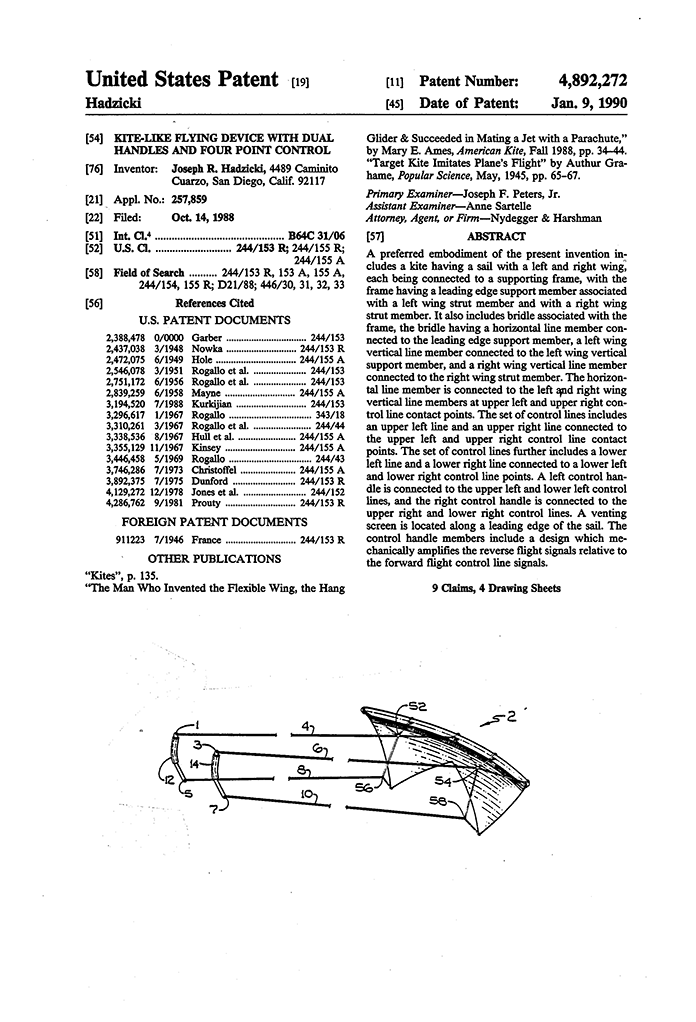
(US 4,892,272 — “Kite-like flying device with dual handles and four point control” by Joseph R. Hadzicki)
Published on September 1, 2025 by Alban Kites
Between quad kitefliers we sometimes reference “the Revolution kite patent,” yet very few flyers have actually read it. This article is my guided tour for pilots—new and seasoned—of what the patent teaches in practical terms. I’ll point to Fig. 1–14 as we go. We’re not discussing the legal claims; this is about ideas, proportions, materials, and why they mattered—and still do.
Credit: This article stands on the work of Joseph R. Hadzicki and the Revolution Kites team, who not only invented the concept but also built and championed the kites that made quad flying take off.
Note: All technical details in this article — including bridle lengths, handle angles, and other dimensions — are taken directly from the original patent text and figures. The figures are based on the patent; we cleaned them up and added the callouts mentioned in the article. They are reported here as part of the historical record, not as design recommendations.
A short timeline
- 1988-10-14 — Joseph R. Hadzicki files US applications US07/257,859 and US07/257,859.
- November 1989 — At International Kite Trade show, Revolution Kites launches the design as “Neos Omega.” The production model is the Revolution 1 (Rev 1).
- 1990-01-09 — US patent 4,892,272 is granted and published.
- 1989–1990s — The same invention is also filed internationally (Japan, Europe, Australia, etc.), and in some cases patents are granted.
- 1992-06-09 — A similar US patent 5,120,006A is granted and published.
- 2008-10-14 — The US patent 4,892,272 expires.
- 2009-06-09 — The US patent 5,120,006A expires.
Why this matters: during its life the patents underpinned Revolution Kites’ practical monopoly on this control concept, and the brand momentum continued for years after expiration. Since 2009, the core teachings are public-domain; many makers now build quads inspired by, or evolving from, this recipe—often with their own innovations. Revolution kites® remains a trademark.
Why this patent was a big deal
The late-80s sport-kite scene was dominated by two-line designs. They could fly forward and loop, but they struggled to stop, fly reverse with control, or pivot inside a wingspan. Some prior art tried heavy mechanisms to deform wings in flight—fine for gliders, poor for beach flying. The patent’s ambition was simple and radical: total controllability with simple parts—fabric, spars, line, and smart geometry.
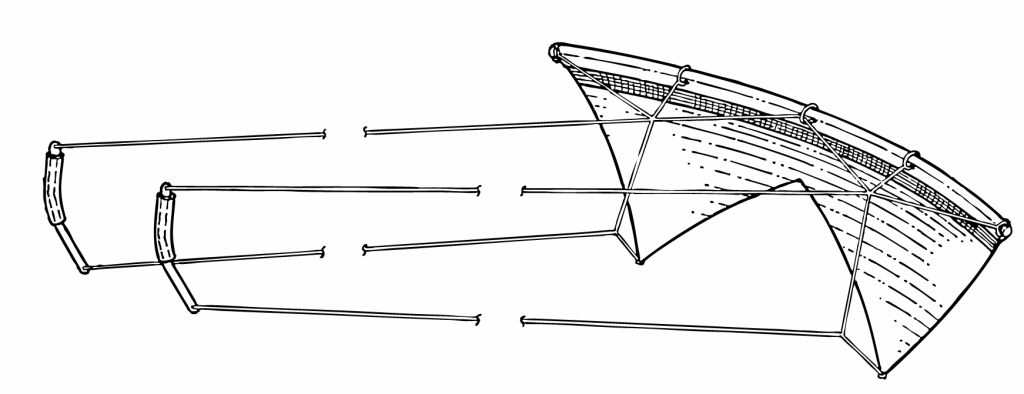
What emerged is a system we now take for granted: a sail plan that splits into two controllable wings, a bridle that gives your hands leverage where it counts, a vented leading edge that “breathes” in reverse, and handles that favor reverse on purpose. Put together, these choices unlocked instant stops, dependable reverse, and very tight turns.
The headline features (what the patent actually teaches)
- Double-V sail on a stiff and resilient frame
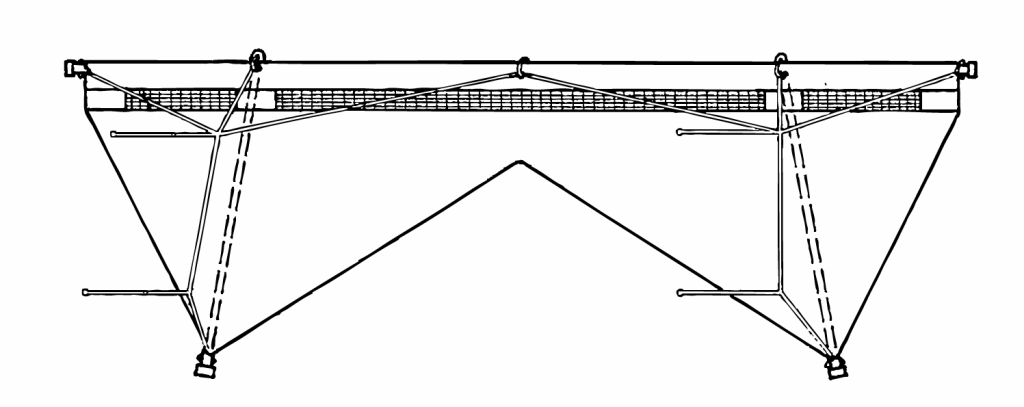
A continuous leading edge plus two vertical struts divides the sail into upper/lower left and right wings (Fig. 2–3). Each half-sail can be inclined or declinated independently via four lines. - Three-member bridle with upper and lower control points
One horizontal bridle runs along the leading edge; two vertical bridles run down the struts. Their intersection near the nose forms upper left/right control points; lower points sit near the wingtips (Fig. 3, 9). This layout is the lever system your hands operate. - Leading-edge vent
A porous screen directly behind the nose (Fig. 10) bleeds off the air pocket that forms in reverse. Result: stable reverse flight and the ability to drive the trailing wing to zero or even negative airspeed in a turn, shrinking the turn radius dramatically. - Handle geometry that amplifies reverse
The grips (Fig. 11–14) are shaped and spaced so a backward roll produces a larger top/bottom line differential than a forward roll. That mechanical bias is the secret behind instant stops and confident reverse liftoffs. - Proportions that make the recipe repeatable
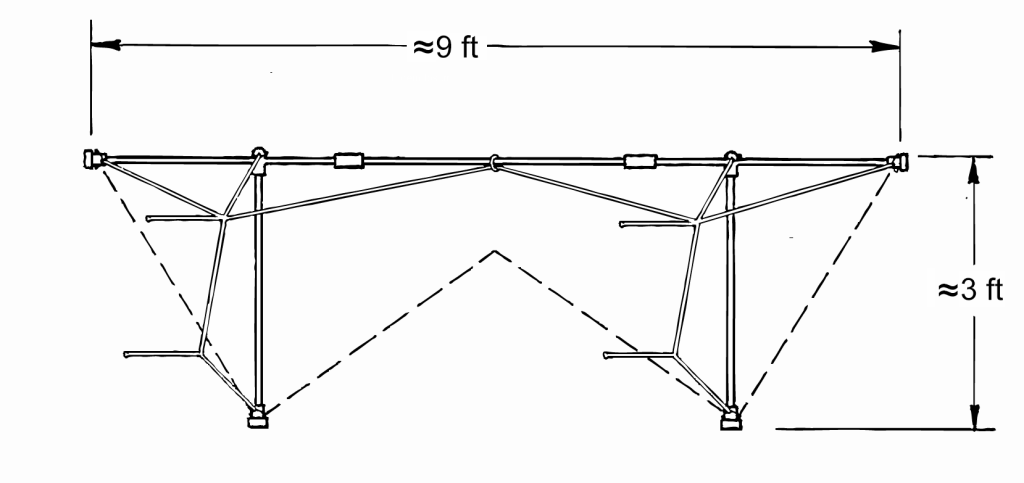
Span to height around 3:1 (e.g., ~9 ft × 3 ft) with corresponding bridle and handle ratios. Scale the kite, keep the relationships, and the behavior scales too.
The background in a nutshell
Earlier devices used two lines or complicated linkages suited to large flexible wings. They could sweep and loop, but lacked continuous speed control, true reverse, instant stops, and tiny radii, especially across a wide wind range. That’s the explicit gap the patent fills—without adding mechanical complexity.
The meat of the description — what matters in practice
Sail plan & materials: light body, tough edges
The sail is a double-V planform with a leading-edge sleeve and a vented panel just aft of it (Fig. 2). Materials suggested: ripstop nylon for the main canopy, Dacron for the sleeve and reinforcements, and a mesh for the vent. Translation for builders: keep the body light, reinforce the load paths, and make the leading edge breathe.
Frame & structure: crisp span, resilient feel
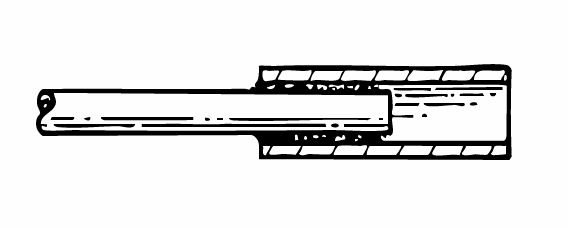
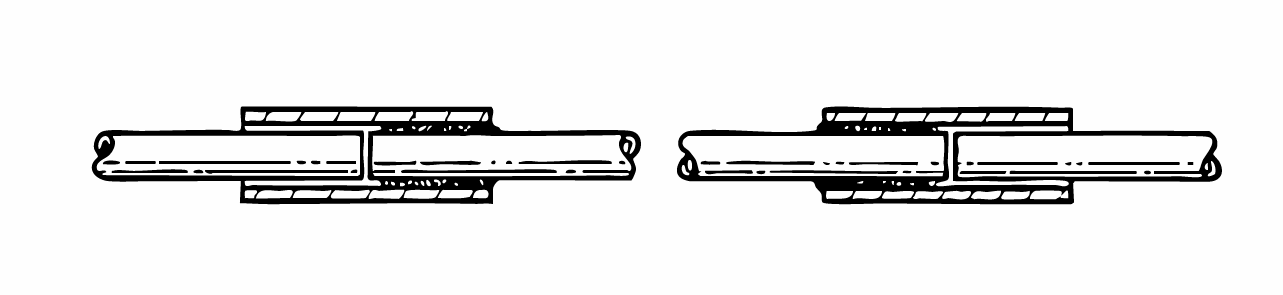
Composite tubes (graphite/S-glass) give stiffness and recovery. The leading edge is spliced at two points (Fig. 4–5) for strength and maintainability. Maintain the 3:1 span/height proportion; that’s the window footprint and roll stability the rest of the system expects.
Strut caps that float
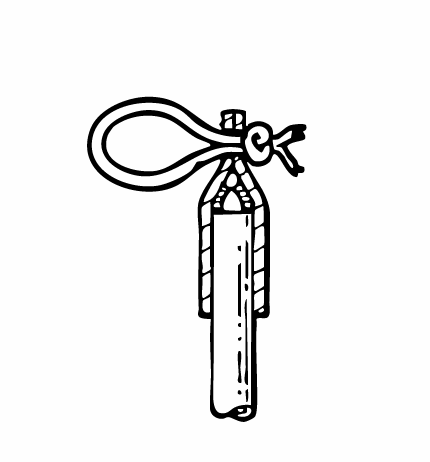
At the strut-to-nose connection (Fig. 6–7), each cap is looped with a small damping element instead of being hard-pinned. That tiny articulation softens gusts, reduces shock, and preserves feel. It reads like a construction detail; it flies like polish.
End plugs that do triple duty
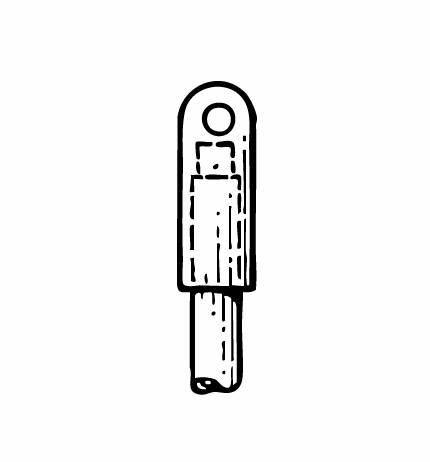
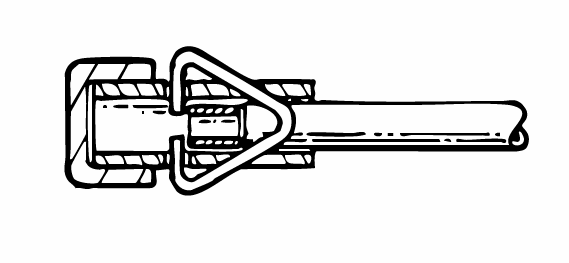
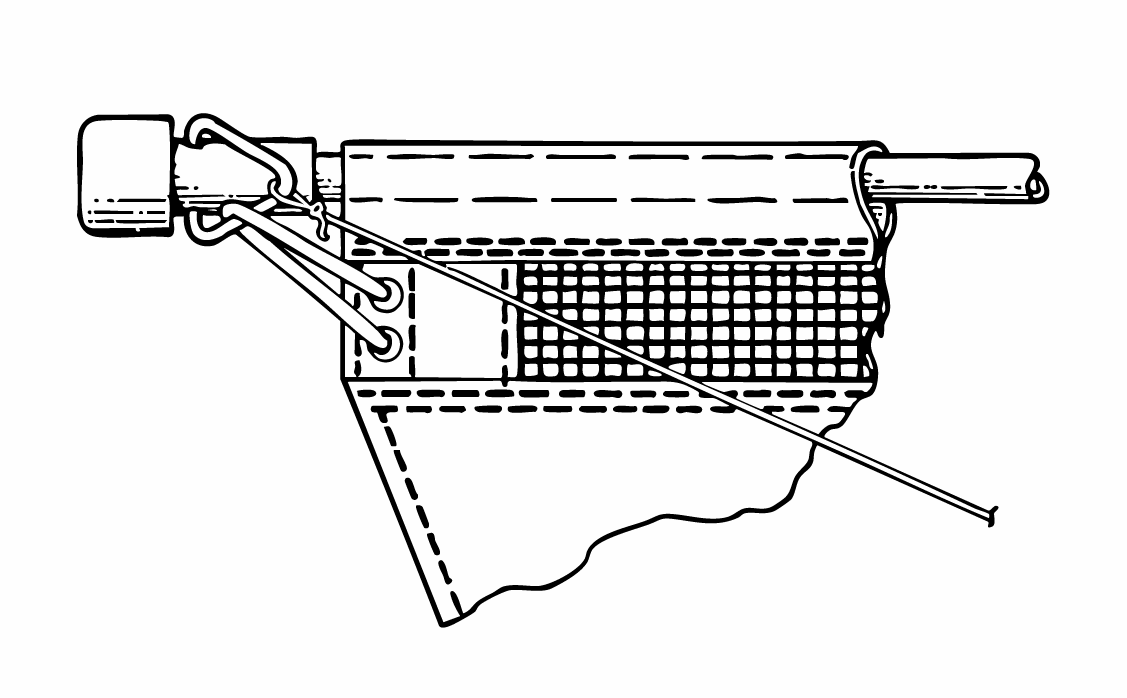
Wingtip plugs (Fig. 8–9) protect tube ends, provide clean anchor points for sail tension and bridle, and soften impacts. Simple and reliable parts.
Bridle architecture (and why placement is fussy)
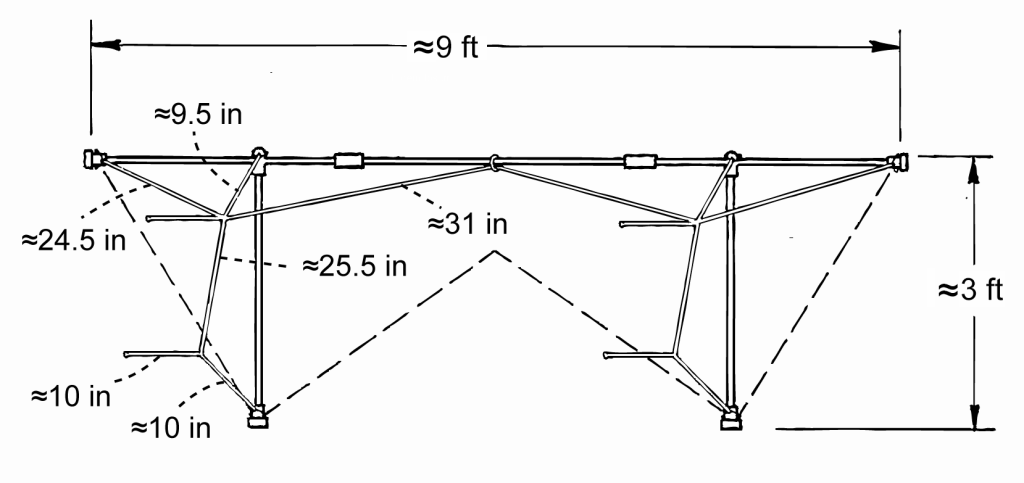
The horizontal member anchors near the tips and loops the center of the leading edge (Fig. 3). The verticals tie at the strut caps above and the plugs below, meeting the horizontal near the nose to create the upper control points. Slide those upper points too far inboard and control goes dull; too far outboard and the leading edge over-flexes. Keep them near the strut/LE region for crisp response without span “banana.”
Figure callout: the Fig. 3 already shows a proven baseline for a ~9-footer. If you scale, scale those lengths proportionally and re-find sensitivity with the lower points near the tips.
Four lines, two hands — what actually changes in the air
With four lines you’re not merely pulling left/right; you’re setting angles on upper/lower halves of each wing. The left grip biases the left half, the right grip the right half (Fig. 1). By mixing those inclinations you don’t just turn—you rebalance lift and drag. That’s why the kite can crawl, hover, or whip depending on tiny wrist changes.
Handle geometry: the reverse superpower
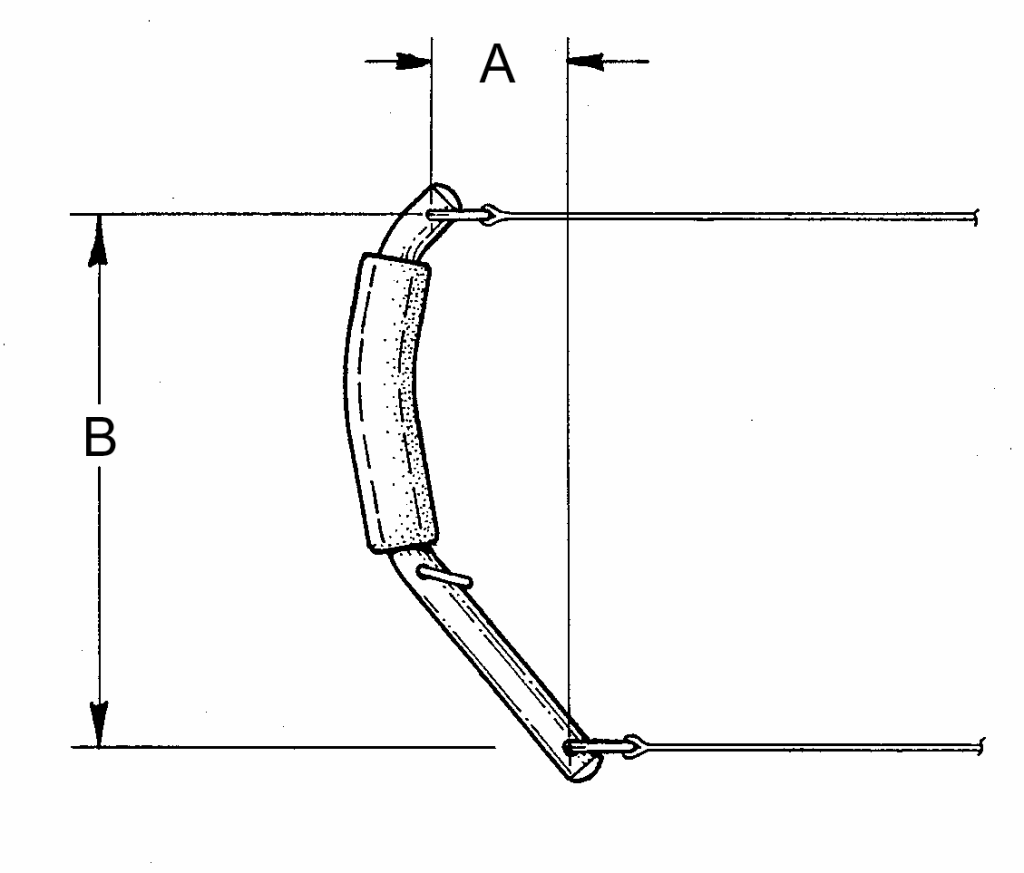
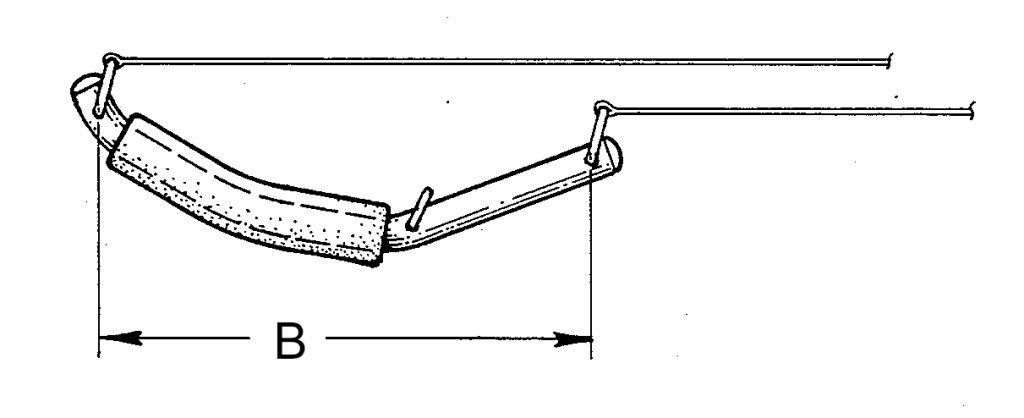
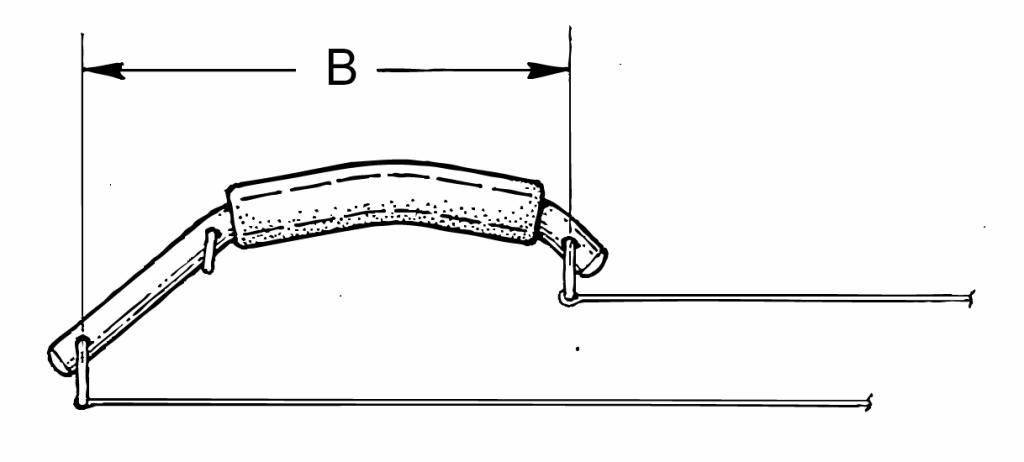
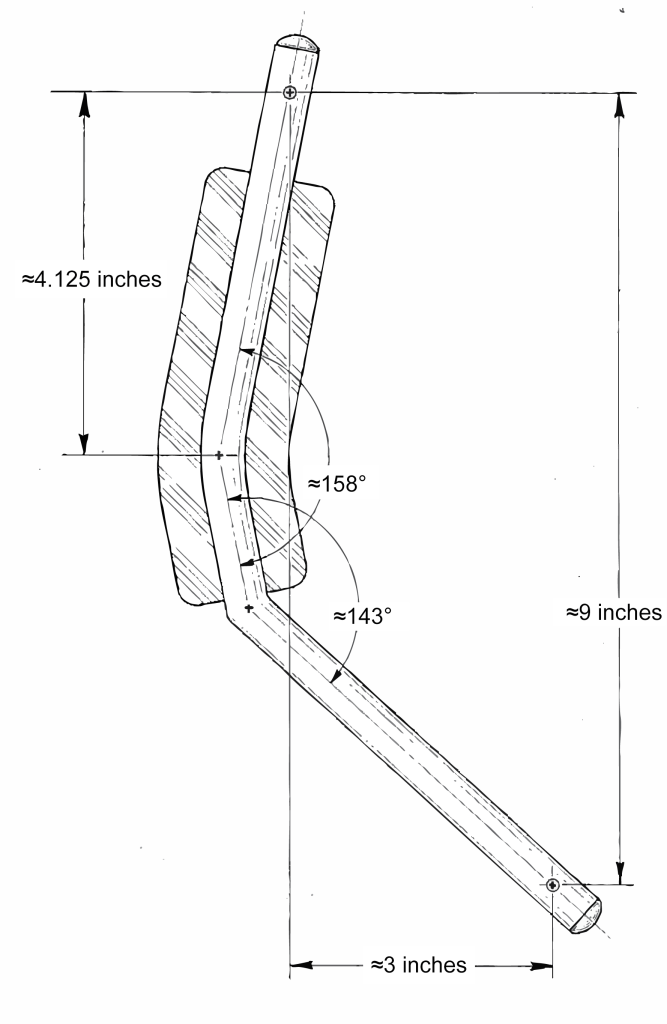
On the handles (Fig. 11–14), the top and bottom line contacts are separated by a vertical distance B and a horizontal offset A (with A ≈ B/3 in the baseline geometry). In neutral (Fig. 11) the effective differential between top and bottom lines is ~zero. Roll the handle forward (Fig. 12) and the differential becomes B − A. Roll the handle back for reverse (Fig. 13) and it becomes B + A. Because B + A > B − A, the same wrist motion yields a larger top/bottom line difference in reverse than in forward—this is the patent’s mechanical amplification. The hand pivot (Fig. 14) sets how quickly that differential ramps with angle, so the kite “bites” into reverse with small, precise inputs. In the air this gives you instant stops, confident reverse liftoffs, and solid backward tracking even in light wind. If reverse feels grabby, ease it by moving the lower control points (or your leaders) out a touch; if it’s too soft, move them in.
The vent: airflow that makes the weird stuff possible
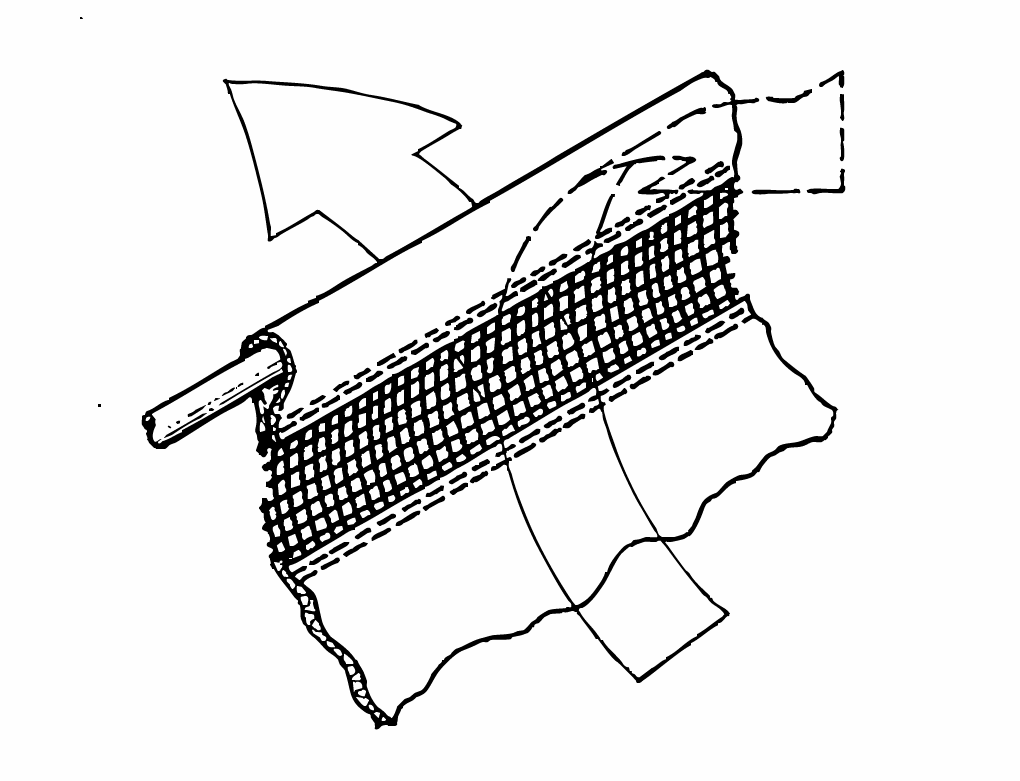
Fig. 10 tells the airflow story. In reverse, air travels from aft toward the nose. Without a vent, that flow piles up at the leading edge and acts like a brake. The vent lets that blocked flow pass through, reducing braking and keeping the flow attached. Payoffs:
- Reverse stability — less wobble, cleaner tracking.
- Half-span turns — you can drive the trailing wing to zero/negative while the leading wing stays powered, pulling rotation around the trailing tip. That’s the “propeller-like” spin the patent highlights.
Scale & variations
The patent explicitly allows alternate bracing as long as it functions like the vertical struts and preserves the control geometry. You can scale sizes if you keep the proportions (span/height, bridle relationships, handle geometry). Change those relationships too much and you’ll still have a quad—but not this quad.
Since expiration: what you’ll see on today’s field
Because the patent has expired, quads are built by many manufacturers and individual builders, often adding their own twists while keeping (or riffing on) the core recipe.
Important note: while the concept is public-domain, individual brands may hold newer IP for later features, and their names/logos are protected. Build, mod, and publish with the usual respect for current rights.
How to read the figures in this article
- Fig. 1–2 — Overview and assembly: orient yourself or a new flyer.
- Fig. 3 — Frame, structs & bridle map with baseline lengths and the “don’t go too far inboard/outboard” reminder for upper points.
- Fig. 4–7 — Construction that affects feel: splices for crispness; floating strut caps for resilience.
- Fig. 8–9 — Wingtip ecosystem: plugs, elastic, bridle tie-ins.
- Fig. 10 — The vent story in one diagram.
- Fig. 11–14 — Handle design and positions with the A/B reverse-amplification geometry.
Why this still matters
Read with 2025 eyes, none of this feels exotic—we all fly quads that stop, back up, and spin tight. In context, the patent packaged a system: structure, bridle, vent, and handles tuned to each other. It wasn’t a single magic trick; it was several simple ones, in the right proportions. That system unlocked the style of quad flying we now enjoy in solo practice, pairs, and team formats.
Wrap-up & further reading
The US patent “Kite-like flying device with dual handles and four point control” by Joseph R. Hadzicki (filed 1988-10-14, granted 1990-01-09, expired 2008-10-14) captured the blueprint for controllable quad-line flight: a double-V sail, a three-member bridle with upper/lower control points, a vented leading edge, and reverse-biased handles, all living inside a roughly 3:1 span/height world. Since expiration, the field has blossomed—multiple makers, thoughtful materials, clever vents, evolving bridles, and handles that suit different hands and goals—yet the original blueprint still explains why our quads behave the way they do.
Thanks to Joe and the Revolution Kites crew for turning a clever idea into a flying culture.
👉 Want to dive deeper? Read the full patents:
- US patent 4,892,272 “Kite-like flying device with dual handles and four point control” by Joseph R. Hadzicki
- US patent 5,120,006 “Kite-like flying device with independent wing surface control” by Joseph R. Hadzicki
Did you like this content?
Do you like this content? Consider becoming a supporter! We’re actively looking for supporters to help us develop QuadKites.org: support our server costs, distribute our content, offer your skills…