
Welcome to the “Novice” format of kite competition by the Fédération Française de Vol Libre (FFVL)! 🪁
⚠️ Note: this content applies to French FFVL competitions only. It is written in English for convenience and educational purposes, as the format and figures are particularly valuable for learning and progression. It does not describe an international competition standard.
Want to discover competition without pressure? The “Novice” format has been designed with you in mind: accessible, formative, and perfect for taking your first steps on the field.
Here you’ll find all the official figures used in “Novice” competitions in France, classified by discipline: individual, pair and team, dual-line and multi-line. They’re all illustrated to help you better understand, visualize and train them.
It’s a great input to help you progress, master the basics… and have fun flying. Ready to get started? 🎯
NB: If you’re doing dual-line kites, take a look at the dual-line tricks: most of them can be done in quad!
These figures and rules are taken from the official FFVL compulsory figures booklet version 1.0 (January 1, 2019). What you see here is a faithful web adaptation of the original PDFs – designed to make it easier to read, learn and practice. Thanks to Marc Levesque for his support!
📘 Want to read the original FFVL documents?
You can download the official French rule books here:
- “Novice” format rules v3.0 in French (January 16, 2019) (PDF), mirror link
- Summary of rules in French (PDF), mirror link
- Compulsory figures book “novice” format v1.0 in French (January 1, 2019) (PDF), mirror link
📂 Explore figures by discipline
You can choose a discipline and browse the associated figures:
- 15 dual-line individual compulsory figures
- 9 dual-line pair compulsory figures
- 10 dual-line team compulsory figures
- 13 multi-line individual compulsory figures
- 12 multi-line pair compulsory figures
- 11 multi-line team compulsory figures
Or you can browse the figures below and choose one to discover the details.
NB: Further down this page, you’ll find definitions to help you get your bearings and better understand the figure explanations.
Dual-line individual compulsory figures


Dual-line pair compulsory figures


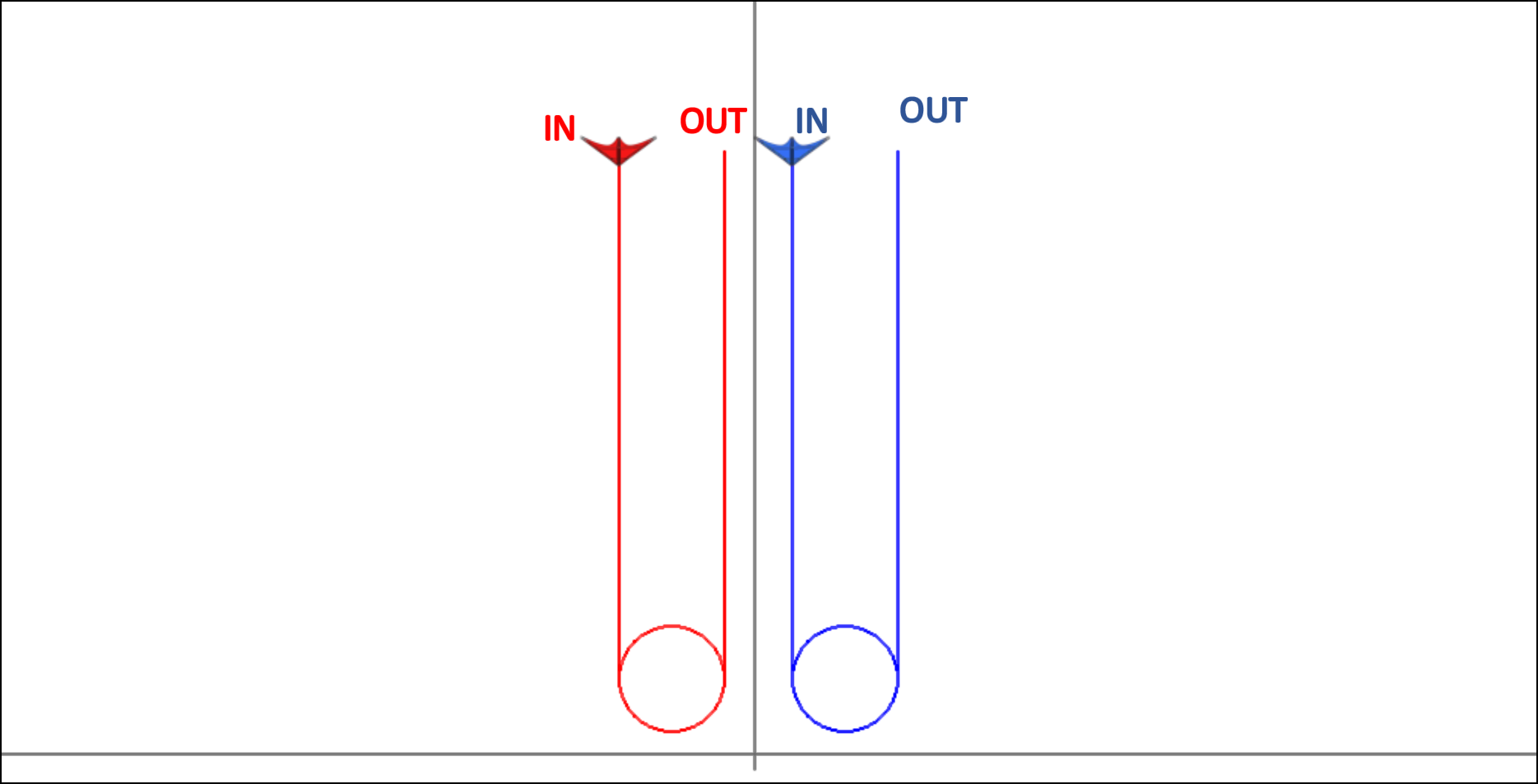


Dual-line team compulsory figures


Multi-line individual compulsory figures


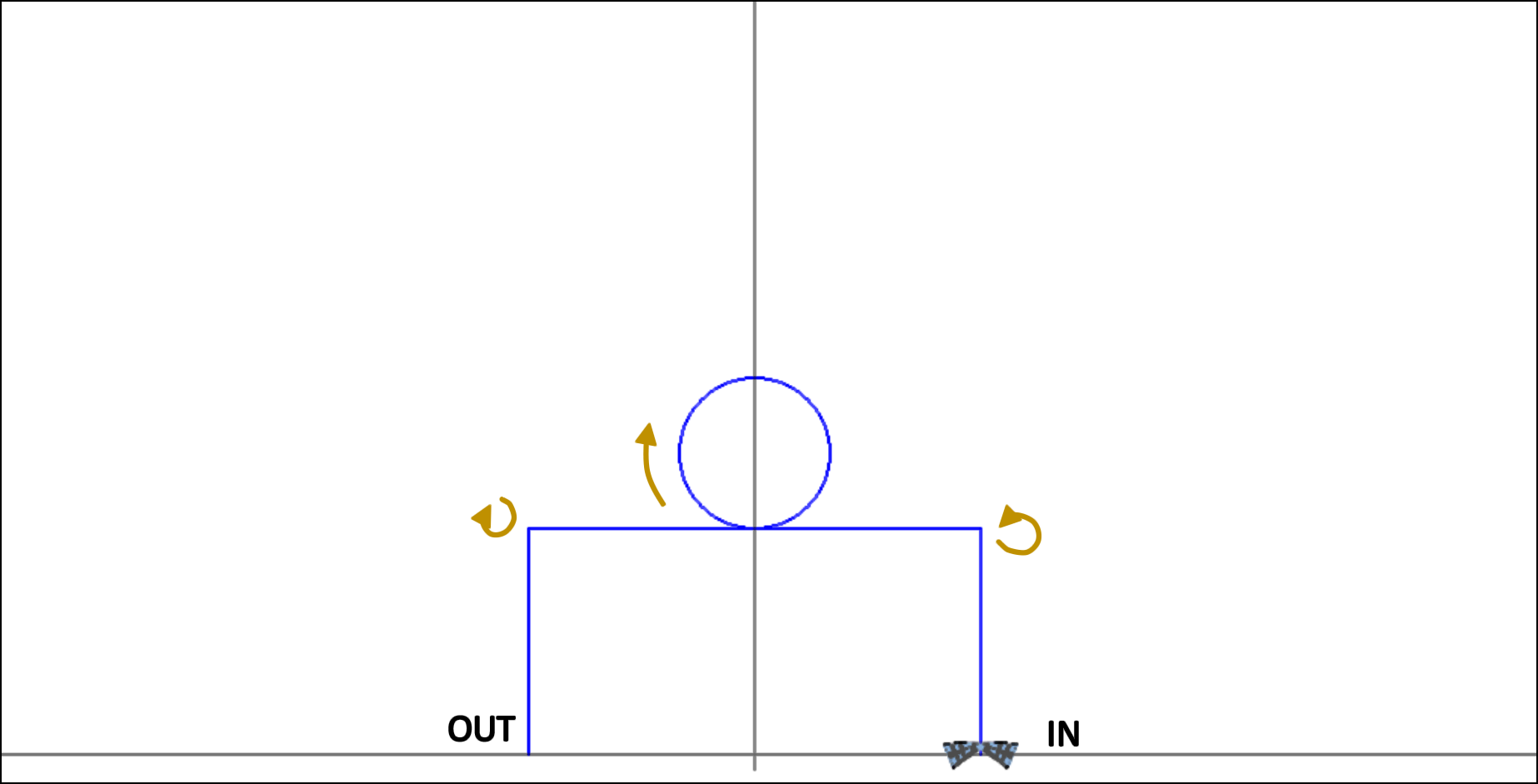

Multi-line pair compulsory figures


Multi-line team compulsory figures


Definitions
General terms
Wind window: The wind window is the semicircular area defined by the maximum height a kite can reach, in all directions, in front of a stationary kiteflier.
The window is limited by the ground, the length of the lines used for flying, the wind speed, the skill of the kiteflier and the flying characteristics of the kite(s).
Center window: The center of the wind window is directly in line with the wind in front of the kiteflier (horizontal center) and halfway to the top of the wind window at the same point (vertical center).
Turn: All turns are clear changes in the direction of flight.
An adjective can be used with the word “turn” or with the verbs “tourner” or “virer” to emphasize an aspect of the turn. If a change of direction is not intended to be a turn, it will be described as an arc or curve.
Lines: Unless otherwise specified, all lines are assumed to be straight. The term “straight line”, although redundant, can be used to emphasize the expected flight.
Horizontal lines: A horizontal line corresponds to flight in a straight line parallel to the horizon.
Vertical lines: A vertical line corresponds to flight in a straight line perpendicular to the horizon.
Parallel lines: Parallel lines are all equidistant from each other. Qualifiers (horizontal, parallel, etc.) are used in the explanation sections to limit the focus to a particular line or lines.
Take-off: A take-off is the transition of a kite from a stationary position on the ground to flight. Control of the kite during take-off and stability of flight after take-off are the most important aspects of a take-off.
Landing: A landing brings the kite to a controlled stop on the ground.
A “nose crash” is not considered a landing.
Unless otherwise stated, no one type of landing is preferred to another.
Geometric figures
General
Most of the figures on offer are based in whole or in part on geometric shapes. In such cases, the general shape of the figure must be respected to remain legible and consistent with the model. In particular, it must not be truncated or distorted.
For example, if the expected figure is :

The 3 situations below constitute execution errors which will be penalized by a lower mark:
Les 3 situations ci-dessous constituent des erreurs d’exécution qui seront sanctionnées par une moins bonne note :


Circles & arcs
A circle, or arc of a circle, must be regular, without waves, and must not resemble a patatoid or oval. Conversely, an oval should not fit into a square.
A distorted circle is also a cause of error.
For example, for the following figure (circle) :

The following executions do not conform to the expected result:


Similarly, for the following “perfect” infinity:

The three executions below will receive a score reflecting execution errors:


Squares & rectangles
As with circles and arcs, shapes based on straight lines must respect a number of key geometric elements, such as angles, length of straight lines, parallelism… For a square or a rhombus, for example, the 4 sides of the figure are supposed to be of equal length, unlike a rectangle whose sides are equal 2 by 2.
For example, a correctly executed square would look like this:
Whereas the examples below correspond to execution errors:
Likewise, for example, for an octagon. As much as an execution like the one below will be considered “perfect”:

The following 3 cases are execution errors:


Definitions specific to multi-pilot groups
Flight in “pursuit” mode
A flight or “chase” mode, or simply “follow”, consists of kites flying one behind the other as if in a train (or caterpillar). In this type of flight, the speeds of the different kites must be controlled to ensure that the distances between them remain constant.
Similarly, in the event of a turn, or more generally in the event of a change of direction of any kind, the kites must perform the change of direction maneuver in the same way and at the same place as the kite in front, in order to maintain the illusion of a “caterpillar”.
Of course, when flying in a straight line, all kites must be aligned on the same line.
Parallel flight
Parallel” flying consists of kites flying exactly the same pattern (same trajectory, same speed, same direction) in different parts of the wind window. Most often, “parallel” flying is performed with kites located horizontally next to each other (left to right or right to left) or with kites located vertically above each other (top to bottom or bottom to top), but this is not a requirement. Parallel-mode executions can be found in which one kite is in the bottom-left quarter of the window, while another is in the top-right quarter. As long as the figure is executed in the same way, and in the same direction, it’s a parallel flight.
Mirror flight
A “mirror” flight consists of kites performing the same figure, but inverted in relation to each other and along a defined axis, as if the trajectories of some of the kites corresponded to the reflection, in a mirror, of the other kites.
Note that for the “reflection in the mirror” illusion to be perfect, the kites must of course move at the same speed and make turns or changes of direction at the same time and with a proportional amplitude to each other.
Synchronicity
In most pair and team tricks (except when in “chase” mode from start to finish), and unless otherwise specified, the kites must be well synchronized, i.e. they must execute the key elements of the tricks at exactly the same time and in the same proportion. For example, turns and other changes of direction, as well as loops, take-offs and landings, must be synchronized.
Spacing
Unless otherwise specified, in most pair and team tricks, the spacing between kites must be controlled so as to remain constant.
Speed control
Unless otherwise specified, in most pair or team tricks, the speed of the different kites must be identical. In the event of acceleration or deceleration, all kites must accelerate or decelerate at the same time and in the same manner.
Definitions specific to the multi-lines discipline
Diagonal flight: The kite moves in a straight diagonal line, maintaining a constant orientation. For example, a movement from the bottom-right corner of the window to the top-left corner of the window, but with the leading edge pointing upright throughout the figure.
Reverse flight: The kite moves in any direction but with its nose (leading edge) pointing downwards.
Reverseflight: The kite moves in the opposite direction to that to which its nose (leading edge) is tipped.
Forward flight: The kite moves in the direction its nose is tipped (leading edge).
Rotation: The kite rotates around any point, which is designated as the center of rotation. The most common points of rotation are the center of the kite or the wing tips. Unless otherwise specified, turns are stationary, meaning that the center of rotation does not move.
Slide: The kite moves horizontally across the window, with its nose (leading edge) pointing upright (horizontal slide), or vertically into the window, with its nose pointing left or right.
Inverted slide: The kite moves horizontally across the wind window (left to right or right to left) with its nose (leading edge) tipped downwards.
📖 Conclusion
The “Novices” format is a great opportunity to make progress, work on your technique, and discover the atmosphere of competitions, without getting carried away.
Whether you’re flying solo, in pairs or as part of a team, these figures will give you a solid foundation for having fun and, why not, meeting other enthusiasts in the field.
So get started, progress at your own pace… and above all, have fun! 🪁
🌍 Going further
Want to continue progressing after the Novice figures?
There are plenty of ways to push your flying further:
- Participatein national competitions in “expert” format, to discover other trick styles and enrich your experience.
- Explore official International Sport Kite (ISK) tricks, used in competitions all over the world ➔ Discover international tricks
- Work on precision and creativity, inspired by the learning paths and tutorials on QuadKites.org ➔ See the tutorials
- Meet other kitefliers by taking part in FFVL competitions, rallies, or simply by joining forums like Au Fil du Vent and Facebook groups to exchange and progress.