
Published on August 22, 2025 by Alban Kites
I wanted to understand how you really prepare for a competition: not the big principles, but what you do “for real,” on the field, in your head, the day before… So I sat down with Jean-Pierre, a passionate pilot, world champion and multiple-time French champion, to hear how he does it. We kept it as a conversation: we both speak in the first person. This article is a faithful transcription of our chat. The words, ideas, and anecdotes are Jean-Pierre’s; I only structured and tightened it for readability.

Where does it start?
Me — When you know you’re going to compete, what do you start with? Do you have a routine, a plan, or does it change each time?
Jean-Pierre — I start with precision figures. That’s my thing, I love it, and it’s decisive in the rankings. Even if your ballet is “average,” if you score high in precision, you stay in the game.
My precision routine varies with wind and conditions, but the attack order stays the same: figures first. I work on the music and the ballet in parallel if I haven’t locked them yet.
Me — Do you train often?
Jean-Pierre — I try to fly two to three times a week when I can. It’s a lot to fit in, but for me it’s pure joy.
And concretely—what do you work on, and how?
Me — In the weeks before, what do you train? Figures, full choreos, mental prep…?
Jean-Pierre — Honestly, I keep it simple: I put the figure book on the ground, weigh it down with a stone, and I repeat. Several times. I do two or three serious runs, then I let myself play a bit, go back to the figures, change things up to avoid boredom. I need discipline, but also a bit of freedom: that feeds the ballet and keeps the fun alive.
Me — Do you train alone or with others?
Jean-Pierre — Mostly alone. I sometimes film myself to watch back, but I mainly use reference cues that are enough for me (more on that in a second).
Me — And the weather? You told me you often have offshore wind where you are.
Jean-Pierre — Yes, and it’s irregular. You need to pick the right sail, manage gusts: a lot of technique. When you then go fly in a sea breeze (laminar on beaches), everything gets easier. People who do the reverse—going from sea breeze to gusty offshore—feel it right away: it’s tougher.
Your reference cues: “counting” and the window
Me — You mentioned “counting” during training. What is it?
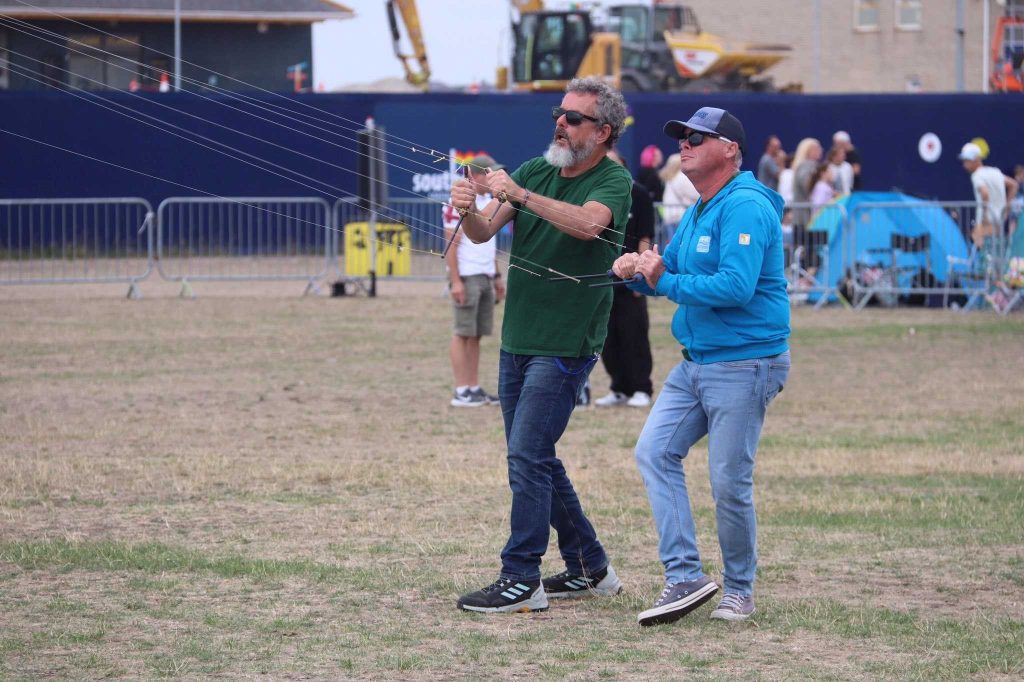
Jean-Pierre — I train by counting. It gives me reference points for speed and height. My step is 10% per count: 1 = 10%, 2 = 20%, … 8 = 80%. And I do this with my 4-line kite on 37 m lines. I use it for both height and width across the window. It’s not millimetric, but it stabilizes tempo and geometry.
Me — And how do you define the window?
Jean-Pierre — Not like the “45° from center” you sometimes see in practice grids. In competition, we talk in percentages (height/width), and you almost never truly reach 100% on either side. So I use counting to sit on 50, 70, 80% consistently, and I also try to push the kite out as far as it will go when needed. The idea isn’t to fly like a metronome: it’s a practical cue to practice cleanly and align with what judges want to see.
Note (for you reading): when Jean-Pierre talks about “percentages,” he means a fraction of the flight window (the space in front of you where you can fly). 50% height isn’t very high; 80% is already high in the window. His “step” is calibrated on 37 m lines—it’s a personal cue to count and set his flying, not a measurement in meters.
Picking the music… and building the ballet
Me — Music and ballet: how do you choose?
Jean-Pierre — It starts with my flying style. I’m fairly dynamic, with sharp breaks, high-energy phases and more settled moments. So I look for music that carries that. Right now, I’m hunting for a new track: I watch a lot of dance, and I pick up gestures and intentions. The music has to make me want to fly and stand the test of repetition; if it bores me after a while, it’s dead.
Me — Do you script the ballet to the last beat, or keep some improv?
Jean-Pierre — Both. I have anchor points where I know exactly what I’m doing, and between those I leave room for improvisation. If I blow a bit or the weather shifts, by knowing the tempo well, I pick the thread back up of the choreo.
Me — And about curveballs… tell me one mishap that stuck with you.
Jean-Pierre — At the World Championships, I was ready to step in… and the wrong track started. Pulse through the roof: I left the kite on the ground, ran to see if I had a USB stick; back on the handles, and they found the right track. Except my focus was broken. Right before restarting, I asked the crowd to applaud to boost me back up. I bounced on my feet, made the kite bounce: it came back, I refocused, and went on. On the video, I can spot the stress mark, even if the audience doesn’t really see it.
Me — So, what’s your plan B in concrete terms?
Jean-Pierre — Have a spare USB stick (check the track, plan a backup), and if things derail, do something to reset yourself: ask for applause, re-engage the body to snap back to tempo. Curveballs happen; what matters is how you come back.
The day before and the morning: the “bubble” and dry runs
Me — What do you do the day before and on the morning of the comp?
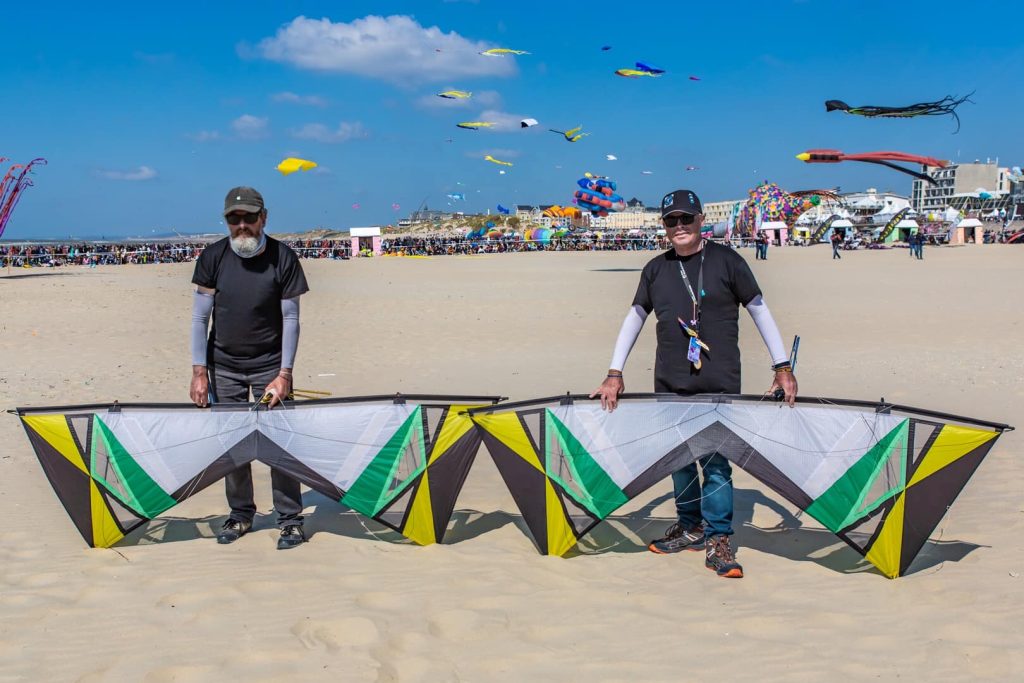
Jean-Pierre — The day before, I’m already in my bubble: I isolate myself a bit, I rehearse mentally. In the morning, same thing, I rehearse with the stick (dry runs on the ground, no flying) and put the music back in my head.
As a pair, we keep that rehearsal mindset like in individual. Bruno and I have different temperaments: he’s more relaxed beforehand and can be more tense at go-time; I’m the opposite. It balances nicely.
What nobody sees: the “invisible” work
Me — What’s the detail or invisible effort that really matters to you?
Jean-Pierre — First, the gear is super important! For years I’ve been refining my sails and my bridle down to the smallest details, a long-term project I’m passionate about. I look for the best settings to optimize my kites’ reactions. Having the right kite for the wind range is a major edge on the way to success.
Then the physical and mental preparation: about a month before, I take care of my body. Diet phases, sometimes fasts. The idea is to feel better for movement and also to clear my head. I cut down on alcohol. Not zero—I might have a small aperitif with my wife on the weekend—but no excess, I stay relatively zen. Simple things, but for me, they really matter.
A tip for a first competition?
Me — If someone is preparing their very first comp, what do you tell them?
Jean-Pierre — Find your people. A club is invaluable. And do workshops or training: with others you learn better. It also gives you a framework and a bit of discipline to progress.
Personal style… and different styles
Me — How would you describe your style? And on the flip side, a very different style you like?
Jean-Pierre — Like I said, I’m rather dynamic with hard cuts—I love energy.
On the opposite side, Marjorie [Truchet], for instance, is all softness, all flow—beautiful to watch. It shows that the music should serve your style: you don’t slap a soundtrack at random; you choose it for the story you want to tell.
Me — Thanks, Jean-Pierre!
To try on your next session
- Precision first: chain three serious figures before you play.
- Counting method: set 1 count = ~10% (37 m lines). Examples: climb “1…5” for 50%, “1…7” for 70%, “1…8” for 80%. Do it in height, then across (center → edge → center). Goal: keep the same tempo out-and-back; don’t chase 100%—it’s rarely reachable.
- Plan B: check your audio track, prep multiple USB sticks, and picture how you’ll “snap back” to the tempo if something goes sideways.
It honestly made me want to get back out there this weekend. You?
Enjoyed this content?
If you like what we publish, consider becoming a supporter! We’re actively looking for help to grow QuadKites.org: cover server costs, spread the word, and bring your skills…