First steps with a Revolution kite by Lyze Kiel
Lyze Kiel published a short video series for a friend who was starting with a Revolution kite. The result is informal, but useful for seeing the first gestures in real conditions.
These videos were filmed on the spot, and their automatic subtitles are hard to use. Each card leads to the video’s page; for the five narrated videos, we provide chapters there with a short summary of what Lyze shows: these are summaries, not transcripts.
Who is Lyze Kiel?
Section titled "Who is Lyze Kiel?"Lyze practices quad-line kites at the Bois de Vincennes in France.
These first steps were initially intended for a friend who was just starting out. Lyze addresses that friend directly in the videos, then made them public so other kite flyers could use them too.
The advantages of these videos
Section titled "The advantages of these videos"- Lyze’s tone is natural.
- The length of each theme seems appropriate.
- Subtitles are available.
Disadvantages of these first steps
Section titled "Disadvantages of these first steps"- The videos are in French.
- Some moments can feel improvised. These videos were not initially produced for a broad audience.
The videos
Section titled "The videos"
Setting up your Revolution kite
Lyze lists useful gear (up to 0:30). He then shows the carbon rods and how to fit them together and set the leading edge (up to 1:50). Then he installs the connectors on the leading edge (to 3:40). Lyze makes the classic mistake of trying to fit the leading edge before checking the condition of the sail and bridles. We recommend unfolding the sail and checking that the bridle is free before fitting the leading edge endcaps. Lyze then mounts the vertical rods. Finally, he checks that the bridle is free.

Unfolding the lines and preparing to fly
Unrolling the two pairs of lines, telling them apart and attaching them to the handles and then the kite. You see how to keep the same logic on each side so that no line crosses another.

The basics of flying
The first flight in light wind: checking the lines, lifting the kite, finding the stable position, then upside down and sideways. You see how to step forward or back to keep your place.
Mastering your Revolution in flight
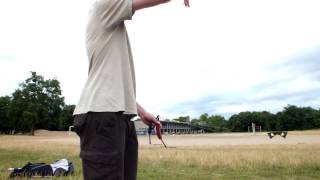
Mastering the Revolution's positions in flight: leading edge up, sideways, then upside down, step by step. You also see how to fly forward upside down and climb back in reverse.

Packing up your Revolution kite
Packing up a Revolution: separating the pairs of lines, winding them in a figure eight, then taking the kite apart facing the wind and rolling the sail without creases.

A quarter turn on the spot
A quarter turn on the spot with a Revolution.

Demonstration of low-wind flying
Lyze flies in light wind, or none at all: the absence of wind lets him fly in every direction.

Demonstration in steady wind
One of Lyze's training sessions in steady wind, after 8 months of regular practice.
Before flying in light wind
Section titled "Before flying in light wind"- Practice first with a steady wind corresponding to your kite’s range. Flying in light winds requires a good level of skill.
- Bring good shoes.
- Check that the ground is flat and free of holes. Watch out for sprains!
- Before you start, warm up by walking several dozen meters backwards.
- Keep your line plate with you. If you’ve gone back too far, you can put the lines away, move forward again and start again!
Continue with the basics
Section titled "Continue with the basics"- Review the basics in a suggested order to connect these videos with practical goals.
- Read Punk Sportif’s beginner guide if you prefer a more detailed written resource.
Last updated: — added key takeaways and summarized chapters under the five narrated videos
Did this page help you?
Saving…
We couldn’t save this feedback.
Thanks, your feedback helps us improve this page.
Thanks, your feedback helps us improve this page.