Experienced — Fly 4 Fun
This section is for pilots who already control the basics and want more vocabulary: transitions, combinations, reverse work, and tighter control in varied positions.

Horizontal flight
Fly the kite to the left edge of the wind window, turn 180 degrees and fly until you reach the opposite edge. During horizontal flight, accelerate slightly and keep the upper handle closer to your body than the lower one.

90° turn
Take off. With the right hand, pull the brake and release; repeat with the left hand and release. Left, right, right, left. Each brake pull lasts about half a second.

Vertical flight
Take off. At the top of the wind window, turn 180 degrees and descend vertically, braking slightly. In medium and strong wind, you can take a few steps forward as the kite comes down.

Vertical side slide
During horizontal flight, stop the kite. To descend, slightly release the upper arm; to ascend, pull the upper arm and, if necessary, take a few steps backward.

Side slide
With the kite in its normal position, pull the left handle to slide left and the right handle to slide right. This exercise is easier in the center of the wind window in medium to strong wind. In light wind, walk backward and keep the kite horizontal and parallel to the ground.

Flic flac
With the kite stalled, give a brake tug while taking half a step forward, then a second brake tug. The flic flac must be done without losing height.

Reverse horizontal flight
During horizontal flight, pull the brakes and stop the kite. Then slightly increase the rotation of your wrists to start the reverse horizontal flight. Always keep the upper handle closer to your body than the lower one.

Advance reverse launch
Brake slightly and the kite takes off in reverse. At about five meters above the ground, pull one brake slightly more and the kite rotates; then accelerate by bending both forearms.

Freefall at the center of the wind window
Stop the Revolution at about three quarters of the way up, in the center of the wind window. With one handle, give a sharp brake tug to one wing, letting the kite make a 180-degree freefall rotation. At the end, regain tension on the lines when the Rev is as close as possible to the ground.

Gaining ground
In light wind, you back up to the end of the field: two ways to regain ground by coming down from the top of the window, with the lines always tight.

Square / rectangle

Vertical pivots
From a hover or the top of the wind window, start inverted flight. Give an accelerator tug with the right handle while pulling the brake with the left one. Repeat three times, rotating on the axis.

Infinity
Fly the kite diagonally up to three quarters of the wind window and slightly pull the left brake and handle, drawing a big curve. After another diagonal, repeat on the right side of the window.

Wing standing
With the kite on the ground, quickly give an accelerator tug on one wing and brake it right after, stabilizing the kite standing on a wingtip on the ground.

Pull & catch and trow-out launch
Pull, catch, throw: dropping the kite from the top of the window, catching it by the leading edge, then throwing it like a javelin and taking control again.

Freestyle routine
All the exercises from the first two chapters, novice and intermediate, can be combined into a freestyle routine.

Inverted side slide
The inverted side slide, from one edge of the window to the other, leading edge parallel to the ground, with two ways into it, one of them easier in light wind.

Bicycle
Starting from the left edge of the wind window, accelerate with the left handle while bending the left arm, and at the same time brake and push the right arm. Then brake and bend the right arm while pushing the left arm. Repeat this alternating movement for the following rotations.

Inward axel
Fly the kite inverted to the right edge of the wind window. When it's stopped and flat enough, give a tug on the left brake while releasing the right arm and taking a few steps forward, letting the lines go slack so the Revolution performs an axel. A well-done axel is as flat as possible.

Horizontal jump
With the kite on the ground, take off and immediately pull one handle, braking gradually.

Inverted flic flac
With the kite stalled in the inverted position, give a brake tug while taking half a step forward, then a second brake tug. The inverted flic flac should be done without losing height.
Walk
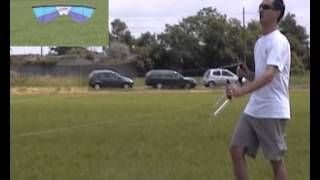
Give an accelerator tug on one wing, then brake to keep the wingtip from lifting off. Walk backward and repeat the movement with one hand, then the other: this is the walk.

Spin on the axes
For a counterclockwise spin, accelerate and bend the right handle while pushing the left one; then brake and pull the left handle while pushing the right one; then bring both handles back to neutral, leading edge up. Reverse the handle movements for a clockwise spin on the axis, without losing height.

Freefall at the edge of the wind window
Fly the Revolution to the edge of the wind window and stop it in the vertical position. With the handle that holds up the upper wing, give a sharp brake tug, letting the kite make a 270-degree freefall rotation. At the end, regain tension on the lines when the Rev is as close as possible to the ground.

Hovering
Take off and stop the kite in the center of the wind window by balancing the tension of the four lines. In the vertical position, always keep your upper hand closer to your body than the lower one. The inverted position is the most difficult. Try to hover the kite again and again until you reach perfect stability by balancing the tension of the four lines.

Reverse vertical flight
With the kite inverted on the ground in the center of the wind window, pull both brakes slightly to start the reverse vertical flight. To fly a straight line, you need fine control of the brakes so the kite doesn't spin.

Circle

Tic toc
Fly the kite vertically downward while walking forward. Then give a brake tug on the forward handle and, at the same time, an accelerator tug on the back handle. Repeat this alternating movement.

Wing tip axel
After a full wingtip rotation, when the kite is in the inverted position, perform an axel by tugging the brake, then recover by stabilizing the Rev.

Rising fade
With the kite on the ground, give a snap tug on the brakes while taking a few steps backward: the Rev flips and takes off in flight position. At about half the wind window, pull your arms slightly; then release them and immediately give a snap tug on the brakes, and the Rev flips back to its normal position.

Rising fade

Ladder
The ladder: half rotations on the tip chained upward then downward, always stopping the kite on the vertical line.

Horizontal ladder
Once you've learned the ladder, try the horizontal version, making half wingtip rotations along a straight horizontal line.
Octagon
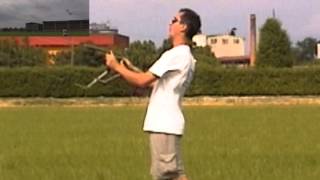
For a clockwise octagon, give an accelerator tug with the left handle and, at the same time, a brake tug with the right handle, then bring them back to neutral. Repeat this movement for each of the octagon's eight corners.

Hops
Hops: taking off from vertical, sliding in a curve and landing vertical again, on one side then the other, with the arm and brake inputs for each phase.

Straight diagonal flight
360

90° clock
The 90° clock: four quarter-turn rotations, from horizontal to vertical, upside down and back, with the move to make just before each stop, keeping the central axis as still as possible.

Ground roll
Accelerate with one handle and, once the kite has passed the vertical, brake slightly to lay the Revolution down smoothly. Then brake with the other handle for the other half wingtip rotation. To keep the Revolution from taking off as it rotates, keep the upper handle slightly further from your body than the lower one.

Snap stall
For a snap stall, give an accelerator tug to the lower wing and, at the same time, a brake tug to the upper wing. Then stabilize the kite in the horizontal position.

Vertical snap stall
Give an accelerator tug on one wing and, at the same time, a brake tug on the other, then stop the kite in the vertical position.

Spin axel
Do one or more spins on the axis; then, when the Revolution is in the inverted position, perform an axel.

Combo spin axel & inverted flic flac

Combo axel & inverted flic flac

Slide axel
With the Rev upside down at about three quarters of the left side of the wind window, start an inverted side slide toward the left. Then give a tug and pull the left arm while pushing the right arm. Afterward, regain line tension and continue the inverted side slide.

Combo slide axel & inverted flic flac

Wing tip rotation
For a clockwise wingtip rotation, accelerate slightly while bending the left forearm, then brake slightly while bending the right forearm. Practice clockwise and counterclockwise rotations until you get excellent results.

Leading edge vertical circle
The circle with a vertical leading edge, broken down eighth by eighth, from the starting acceleration to braking at the top and the descent.

Leading edge up circle
With the kite leading edge up, pull the left handle and accelerate slightly. After a quarter of a circle, push out the left handle and start pulling the right one. At the half circle, start braking and slightly push out the right handle. Then, at three quarters of the circle, pull the left handle.
Go back to the Novice level to consolidate the basics, or move on to the Master level for the densest part of the course.
The same quad-line moves take another shape elsewhere in Fly 4 Fun — no need to finish the progression first:
- Explore the ballets to see how movements become choreography.
- Discover funky flights to try a freer, more expressive style of flying.
- Practice compulsory figures to test your precision against repeatable patterns.
Last updated: — own page, split out of the single combined video list
Did this page help you?
Saving…
We couldn’t save this feedback.
Thanks, your feedback helps us improve this page.
Thanks, your feedback helps us improve this page.