Master videos — Fly 4 Fun
This section gathers the densest part of the course: demanding control, advanced sequences, precision work, and movements that need patient repetition.

Moon walk
Starting from the right edge of the wind window, brake with the right handle, pull the right arm and push the left arm. Then accelerate and pull the left arm, then push the right arm. Repeat these movements for the following rotations.
Quick steps

Outward axel
Fly the kite down to the right edge of the wind window and brake it while taking a few steps forward. When the kite is almost flat, give a snap tug on the right brake while pushing the left arm. This is the most difficult axel, because the kite spins outward, which increases the risk of failure from lost lift. Done perfectly and almost flat, the outward axel is the most spectacular axel.
Quick squares
For aggressive 90-degree spins, give a brake tug to one wing and an accelerator tug to the other at the same time.

Reverse square
With the Revolution on the left side of the wind window, start with a reverse horizontal flight. Do a 90-degree spin on the axis, then a reverse vertical flight, a 90-degree spin, a reverse horizontal flight, a 90-degree spin and a reverse vertical flight. Repeat many times, making squares clockwise and counterclockwise.
Toe walk
With one handle, give an accelerator tug while bending the forearm. Repeat with the other handle, alternating right and left. After the accelerator tug and the following brake, push the right arm, then keep alternating right and left while walking backward.

Quick walk
Once you've mastered the walk, do the exercise again with faster alternating movements between the right and left handles: this is the speed walk.

Reverse diagonal flight
With the kite in a diagonal position, brake slightly and fly straight diagonal lines upward, then straight diagonal lines downward.

Reverse diamond
Swing
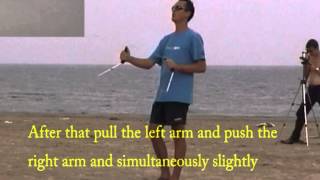
The swing: a 180° downward rotation on the tip that stops the Revolution on the horizontal line, from left to right and back.

Swing (2)

Ground yo yo
When the lower wingtips are about 10 cm from the ground, give a snap tug on the brakes while walking forward. Then give a snap tug on the brakes and take one step backward. Snap the brakes again while walking forward, and the kite lands on its back. Then, when the lines are taut, snap the brakes again while taking half a step backward.

Ground tick tock
For the ground tick tock, do the same movements as the tick tock while taking small steps backward.

Reverse ladder
With the kite stopped vertically, brake with the right handle. After a quarter of a circle, slightly push the left arm and start pulling the right one. Repeat the movement in the opposite direction, always stopping the kite on the vertical line. For the upward wingtip rotation, help yourself by stepping back a few steps.

Quick ladder down
The ladder down can also be done at high speed; the slow motion shows how. Give an accelerator tug while bending one forearm and, at the same time, a brake tug while pushing the other forearm. Repeat the double movement in the opposite direction when the kite is on the vertical line.

Reverse wing tip rotation
Pull and slightly brake the left handle, then pull and brake the right handle. Try the reverse wingtip rotation clockwise and counterclockwise.

Inverted diagonal flight
Inverted diagonal flight: sliding diagonally upward, stopping upside down, then sliding diagonally back down and landing, keeping the leading edge parallel to the ground.

45° clock
With the kite stopped in the center of the wind window, accelerate with one handle and brake with the other, then return to neutral and hover. Repeat for the next 45-degree spins.
30° clock

Diagonal clock

Quick clock
Now that you've learned the clock and the 45-degree clock, try the clock with smaller angles and much quicker movements. This exercise is a real burst of energy: alternate bursts of speed with sharp braking, using the handles alternately, and walk backward to keep your speed. It's important to do it without losing height.

45° pivots

Diagonal pivots
Start with the kite at the top left edge of the wind window. Fly a straight diagonal line downward, flying backward. Then make an inverted diagonal slide, fly forward, make a diagonal slide, and land.

Tug & stop
Fly the kite up to three quarters of the wind window. Hold both handles in one hand and turn 180 degrees; with the other hand, pull the upper lines. The kite drops with no wind on the sail, like a free fall. While it falls, grab the handles and regain control as close to the ground as you can.

Snap slide
Starting from the edge of the wind window, fly a high-speed horizontal trajectory. Just before the center of the window, make a snap stall and immediately a side slide, always keeping the Rev parallel to the ground.

Diagonal snap stall
From a diagonal trajectory, give an accelerator tug to the lower wing and, at the same time, a brake tug to the upper wing. Then stabilize the kite in the diagonal position.

Inverted snap stall
For the inverted snap stall, give an accelerator tug to the upper wing and, at the same time, a brake tug to the lower wing. Then stabilize the kite in the inverted horizontal position.

Vertical spike
For the vertical spike, do a vertical stall, then pull the lower arm to land on the tip of the leading edge.

Snap landing
Do a fast power dive. At about three meters from the ground, do a 180-degree stall and pull both brakes. In strong wind, you need to react very quickly.

Snap landing
The snap landing: a full-speed dive, a sharp rotation close to the ground and a landing on both lower tips, with the mistake that breaks the leading edge.

Geo jump
Fly the kite to the left of the wind window and let it land on the left wingtip. Starting with the right arm closer to your body than the left, slightly pull the right brake and immediately bend and accelerate with the left hand. Then pull the left brake, push out the left arm, and immediately bend and accelerate with the right hand. Repeat this sequence for the following geo jumps, taking a few steps backward if needed.

Ground axel
With the Revolution inverted on the ground, slightly pull the brake lines until the wings are as flat as possible. When the kite is almost flat, make an axel by taking a few steps backward, then a few steps forward.

Leading edge down circle
With the kite leading edge down, pull the right handle and brake lightly. After a quarter of a circle, push out the right handle and start pulling the left one. At the half circle, start releasing the brakes and lightly push out the left handle. At three quarters, pull the right handle. Do these circles clockwise and counterclockwise.

Leading edge in circle
The circle with the leading edge inside, broken down eighth by eighth: the arm and brake inputs at each stage of the turn.

Reverse circle
The reverse circle, a very hard figure, broken down quarter by quarter: the brake that stays pulled most throughout and the arm work at each stage.

Leading edge out circle
With the kite upside down, pull the left handle and walk backward to draw a half circle upward. At the top, push out the left handle and take a few steps forward to draw the half circle downward. Do these circles clockwise and counterclockwise, with the leading edge always facing outward.

Smile
Once you can fly the leading edge out circle, try the smile: alternating leading edge out half circles toward the ground.

Dark side
The dark side, a trick the author named in 1997: landing the Rev upside down on its lower tips with a sharp tug on the brakes, then two ways to take off again.

Combo multiple axel & multiple inverted flic flac

Combo spin axel & dark side

Combo axel & dark side

Quick diamond

Pancake
This trick works best in light wind with an ultralight Revolution. Do a power dive with both handles near your hips. When the kite is about one meter from the ground, push both arms out while taking a few steps forward. To recover, pull your arms and take one step backward.

Marionette
Hold both handles in one hand. With your free hand, give a quick jerk on the upper lines, then walk backward and give a quick jerk on the lower lines. The marionette can be done in light wind.
Dead launch
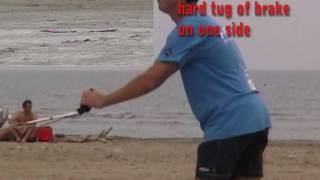
With the Revolution lying flat, take a few small steps backward to tension the lines, then give a hard brake tug on one side: the kite spins and takes off. The dead launch with the Revolution only works on flat surfaces, such as short grass or hard sand beaches.

Combo pancake, axel, dark side & ground tick tock

Quick 180° spin

Vertical flic flac
With the Revolution stopped vertically, do a flic flac with more sensitive wrists. The two brake tugs must be precisely synchronized, and the flic flac must be done without losing height.

Combo vertical flic flac & 180° snap spin
With the kite in the center of the wind window, do a vertical flic flac and immediately a 180-degree snap spin on the axis. The combination must be done without losing altitude, so the vertical flic flac has to be very quick. It's one of my favorites because it's very difficult to do perfectly.
Multiple flics flacs

Ground vertical flic flac

Diagonal flic flac

Combo 4 flic flac

Flic flac in pair

Combo slide axel & dark side

Ground cascade
Fly the kite down, inverted, in the center of the wind window. Do an axel in one direction and, before the kite completes the rotation, another axel in the opposite direction. Repeat this alternation as many times as you like: this is the ground cascade.

Revola
The revola is basically a half axel followed by a full flic flac. Fly the Rev down in the center of the wind window and start the axel; when the leading edge faces you, finish with the flic flac.

Revola landing
Fly the kite down, inverted. At about one and a half meters from the ground, do a half axel followed by a full flic flac, then slightly pull the brakes to let the kite land.

Multiple axels

Combo powerdive, snap landing & ground flic flac
This combination is one of my favorites, because it mixes speed, risk, precision, trick and adrenaline.

Spin circle
Once you can rotate on the axis while traveling in a straight line, as in the bicycle or the moon walk, try rotating while following a circular path. This exercise requires the highest precision and is almost impossible to perform perfectly.

Combo reverse ladder up, powerdive, snap landing & ground flic flac

Flicopter
With the kite three quarters up in the center of the wind window, give a tug on the brakes. Wait until the wings are parallel to the ground again, then pull one wingtip's brake, letting the kite make a 180-degree freefall rotation. At the end of the free fall, regain line tension as close to the ground as possible.

Multiple outward axel
Fly the kite upside down to the right edge of the wind window and make the first outward axel. When the kite has completed the rotation, do the next axels one after another, then repeat at the left edge of the window. The most spectacular axels are those done with the kite as flat as possible. Multiple outward axels are very risky, with a high chance of failure and crashes.

Dark side sartina
The dark side sartina, an evolution of the dark side: a sharp tug on the brakes at the end of a fast dive to land the Rev on its lower tips, and two ways to take off again.

22,5° clock
Once you've learned the 30-degree clock, try the clock with smaller angles: here is the 22.5-degree clock.

18° clock
Once you've learned the 22.5-degree clock, try 20 equal movements around the kite's center point: this is the 18-degree clock. One of my favorite exercises, because it requires the highest precision and is almost impossible to perform perfectly.
Multiple flics flacs 2015

Fade dark side

Dark side fade 2013
The dark side fade, a 2013 trick: after a fast dive, a sharp tug on the brakes to tip the Rev into a fade on its back, and the small steps that keep it there, with the mistake that makes it fall.
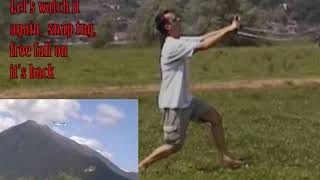
Flic fall flac
With the kite stalled three quarters up in the center of the wind window, give a snap tug on the brakes and walk forward, letting the kite free-fall on its back. At the end, give a final snap tug on the brakes while taking one step backward.

Flic fall flac landing
For me, the flic flac landing is one of the most difficult tricks, which is why it's one of my favorites. With the kite stalled about three quarters up in the center of the wind window, do a flic, then a free fall on its back. At about one meter from the ground, do the final flac and land at the same time. The hard part is finding the exact timing for that final flac landing.
Go back to the Experienced level if you want to revisit a step.
The same quad-line moves take another shape elsewhere in Fly 4 Fun — no need to finish the progression first:
- Explore the ballets to see how movements become choreography.
- Discover funky flights to try a freer, more expressive style of flying.
- Practice compulsory figures to test your precision against repeatable patterns.
Last updated: — own page, split out of the single combined video list
Did this page help you?
Saving…
We couldn’t save this feedback.
Thanks, your feedback helps us improve this page.
Thanks, your feedback helps us improve this page.