The basics of flying
This page suggests an order for setting up, launching and beginning to control a quad-line kite. It brings together resources from several authors: it is a QuadKites.org selection, not a single official method.
Videos are in English or French. You can activate subtitles in the YouTube player if you need to: how to activate subtitles.
Thanks to all the video authors for sharing their tutorials.
A suggested order for getting started
Section titled "A suggested order for getting started"- Prepare your equipment before going to the field.
- Choose suitable wind and a safe flying field.
- Launch, turn, stop and land.
- Practise reverse flight and relaunches.
Move at your own pace and compare several videos when one explanation does not work for you. In the field, always favour safety and control over height or speed.
1. Prepare your equipment
Section titled "1. Prepare your equipment"Goal: recognize the main parts of the kite, set it up, lay out the four lines and pack everything without tangles.
Try this: rehearse the complete setup and packing process in a sufficiently large wind-free space before your first trip to the field.
Continue when: you can orient the leading edge, position the vertical rods and correctly connect all four lines to the kite and handles.
Presentation of a Revolution kite and its lines
Section titled "Presentation of a Revolution kite and its lines"Five videos on this page come from the Now’Air team, a Paris-region team that flies precision ballets: read more about the team and see its ballets.

Introducing the Revolution and its lines
An introduction to the Revolution 1.5 and its lines, opening the Now'Air team's series. You see what line length to choose as a beginner and how to store them.
Setting up your Revolution kite or similar kite
Section titled "Setting up your Revolution kite or similar kite"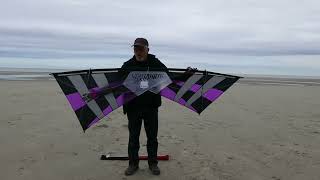
Setting up your Revolution
Taking the Revolution out of its bag and assembling it: leading edge, vertical rods, then a check of the bridle.
Assembly and disassembly
How to put a quad together and take it apart smoothly, with small habits that save time, protect your frame, and keep lines tidy — ideal when you’re new or packing up on sand or wet grass.

Assembling a quad kite
Identify the parts and assemble the frame correctly before the first flight.

Setting up your Revolution kite
Lyze lists useful gear (up to 0:30). He then shows the carbon rods and how to fit them together and set the leading edge (up to 1:50). Then he installs the connectors on the leading edge (to 3:40). Lyze makes the classic mistake of trying to fit the leading edge before checking the condition of the sail and bridles. We recommend unfolding the sail and checking that the bridle is free before fitting the leading edge endcaps. Lyze then mounts the vertical rods. Finally, he checks that the bridle is free.
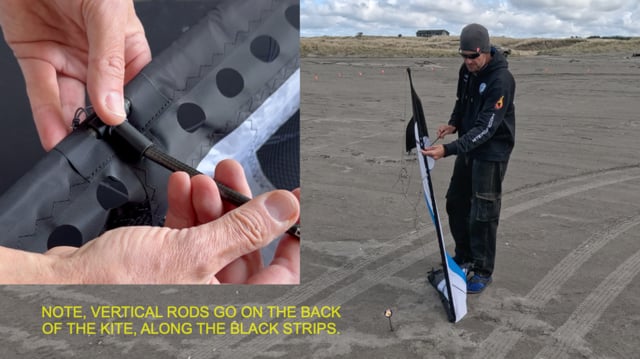
Polo Kites shows which way to put the connectors for the vertical rods: Facebook post.
Disassembling your Revolution kite or similar kite
Section titled "Disassembling your Revolution kite or similar kite"
Packing your Revolution
Taking a Revolution apart and rolling its sail into its bag without damaging it. You see the order of the rods and where to put the bridles.

Packing up your Revolution kite
Packing up a Revolution: separating the pairs of lines, winding them in a figure eight, then taking the kite apart facing the wind and rolling the sail without creases.
Setting up your lines
Section titled "Setting up your lines"
Setting up your Revolution's lines
Attaching the lines to the kite, unrolling them and holding the kite on the ground before take-off. The video stresses the checks at each step.
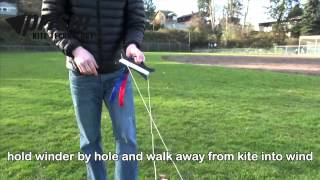
Unwinding a line set

Unfolding the lines and preparing to fly
Unrolling the two pairs of lines, telling them apart and attaching them to the handles and then the kite. You see how to keep the same logic on each side so that no line crosses another.

Sorting out the lines before flight
Prepare all four lines without creating unnecessary twists or knots.
Line management
Section titled "Line management"
Line management
Winding and unwinding your lines without twists, from pinning the kite to the ground to setting up again. You see why most twists disappear once the lines are tensioned.

Revolution Line Management for Your Rev Kite
Line management, from the factory line set to winding in a figure eight, with a method for untangling before attaching the kite and for undoing a bad tangle.
Putting your lines away
Section titled "Putting your lines away"This video from Sportkite.org shows Spencer Watson winding and unwinding quad-line lines quickly and cleanly. Practise it at home as much as on the field: tidy lines avoid tangles and keep the flying field clear for others.

Fast wind and unwind of sport kite lines
This video from Sportkite.org shows Spencer Watson winding and unwinding quad-line lines quickly and cleanly. Practise it at home as much as on the field: tidy lines avoid tangles and keep the flying field clear for others.

Packing the Revolution's lines
Winding your lines on the winder in a figure eight, then securing them so they come out without twists.

Winding a line set
Attaching lines to handles
Section titled "Attaching lines to handles"
Larks head knot
The larks head knot, which attaches the lines to the handles and the kite. You see how to tighten it so it does not let go in flight, and the pull-tab trick for undoing it with gloves.

The larks head knot
Learn the knot used to connect flying lines to the bridle and handles.
Additional setup and frame resources
Section titled "Additional setup and frame resources"These two videos can wait until after your first sessions. They cover more advanced setup and replacing the leading-edge rods.

Assembly and disassembly
Assembling, taking apart and rolling up a Revolution without damaging the sail or the bridle. You see where to stand relative to the wind and how to check each end cap.

Changing frames
Changing a Revolution's frame without detaching it from its lines, by pushing or by bending the rod. You see how to keep the new rod from jamming next to the old one.
2. Prepare your first session
Section titled "2. Prepare your first session"Goal: choose a clear space, check local rules and fly in wind that suits your equipment and experience.
Try this: before leaving, check the wind direction, average speed and gusts, then identify the obstacles around the field.
Continue when: you can identify the flying area and keep people, roads, trees and power lines at a safe distance.
Safety rules
Section titled "Safety rules"Safety is essential for you and for everyone around the flying field.
Here are some basic rules to check regularly during your flying sessions: Safety rules.

Safety
Safety rules before flying: space in front of you, spectators behind, animals, and the places and conditions where you should never fly.
Choosing your flying site
Section titled "Choosing your flying site"Before going to the field, use tools such as Google Maps to inspect the location and check the weather forecast. Flying objects may be restricted in some places. Where flying is allowed, some fields will suit the wind direction better than others.
You can find tips on :
- Choosing your flying spot - WindR
- Finding a place to fly - Prism kite technology

3 Tips for Flying Your Rev in Small Spaces and Challenging Locations
Flying the Rev in a small park surrounded by trees, where neither a single-line nor a dual-line kite would fit. Three tips for spending more time in the air than resetting the kite, then a progression from beginner to advanced.
Anticipate the wind strength
Section titled "Anticipate the wind strength"Check the weather before heading to the field. Wind forecasting websites and apps can provide both the average wind speed and the expected gusts.
Here are the weather forecasting applications:
- WindFinder - Website - Google Play - App Store
- Windy Website - Google Play - App Store
Tips are available for guessing wind strength from the field:
- Wind strength - WindR
- Wind speed - Prism kite technology
- Beaufort scales - Kite service

What Is the Wind Range of My Revolution? Tips and Tricks to Increase Your Wind Range
A Revolution's wind range has two sides, the model's and the pilot's: what really limits it, how to widen it, and which model to choose for your wind.

Revolution Flying Strategy: Different Wind Conditions
Building a flying strategy for the wind: choosing tricks suited to the conditions and to your level, practising carefully in high wind, and choosing the right Rev.
3. Launch and control
Section titled "3. Launch and control"Goal: understand the handle inputs, launch, change direction, stop the kite and return it to the ground cleanly.
Try this: repeat small launches, a stable stop and a controlled landing without trying to fly high.
Continue when: you can repeat a launch and landing while keeping the kite within the area you chose.
Using your handles to fly
Section titled "Using your handles to fly"
Using the handles
Thierry presents the main handle inputs and their effect on each half of the sail.

Grab the handles, move your body
Hold the handles lightly and use body movement to preserve line tension.

The perfect quad-line lesson for two-line pilots
The lesson for pilots coming from two-line kites: on a Rev, pulling a handle does not turn, it slides; the turn comes from rotating the handle.

When to pull your Rev: it's not what you think
On a Rev, pulling is not for turning: the two real reasons to pull, sliding and speeding up, with a slide exercise towards the center of the window.
Thierry explains more about hand movement according to the desired movement on his blog KiteJust4Fun.
The launch position
Section titled "The launch position"
Launch position
Getting the kite ready to take off: safety position, handles on the stake, then turning one half-wing over without twisting the lines.
Launching
Section titled "Launching"Tutorial 1

Getting started and first launch
Thierry is blunt about it: launching with the sail loaded is “the most important lesson”. He skipped this step himself, because of his indoor gliding Rev practice and a first quad-line flown with a slack sail, and says it cost him two years before he understood that loading the sail is essential to flying a Rev.

Launch and control
Taking off, balancing the kite and landing it, then flying from one point of the window to another. You see the very light pressure on the handles that is enough to control it.

The Revolution launch: 6 key techniques
Six ways to launch a Rev, from the standard launch to the dead launch, with the common mistakes of each and what the Reflex changes when the wing is face down.
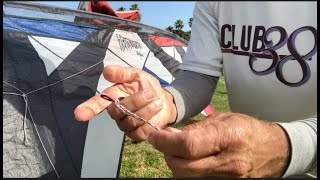
Guarantee success on your first Revolution launch
The simplest way to succeed in your first session with a new Rev: straighten the lines if they are twisted, and stick to Club 38 level-one skills.
Tutorial 2
The wind window
Section titled "The wind window"
Wind window
The shape of the wind window and its power zones, from the centre to the edges. You see how to fly in orbit around the centre and divide the window into a grid to know where you are going.
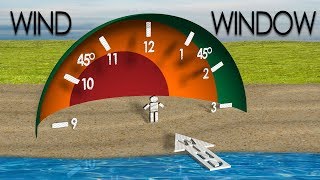
The wind window
The wind window explained for kitesurfing: a half dome downwind, described with the hours of a clock. Useful for quad-line flying to understand where power peaks and how the wind shifts it.
Wind window
See where the kite can and should fly. Think of the sky as a grid so you can place the kite with confidence, feel the power zones, and keep lines and stops clean.

Wind window
Once you've mastered the elevator, start exploring the wind window: try flying across the whole window, from the center to the outer edges.
Making turns and flying horizontally
Section titled "Making turns and flying horizontally"
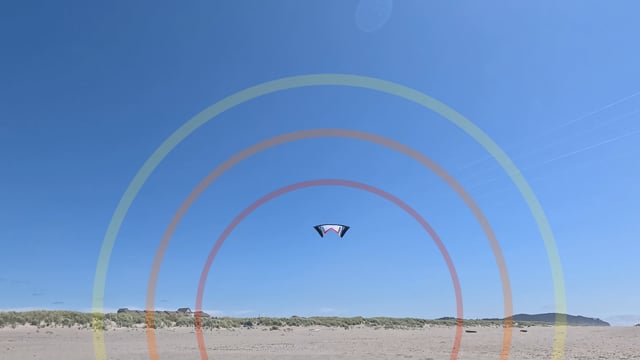
Turns and horizontal flight
The first controls: the emergency stop, the turn and the compensation that keeps the kite from falling. You finish with straight lines, each ending in a clean rotation.

Turning
Understand and repeat a first basic turn while keeping the trajectory under control.
Doing a figure 8
Section titled "Doing a figure 8"
Figure 8
The figure 8, a holding pattern for team and solo flying, high and then low. You see how to keep momentum in the turns and fill the window with four fixed points.
Figure 8 and 180s
The figure 8 and 180s, high and low, with the image of a rectangle to structure the path. You see the low 180 used in team flying and how to practise it at three altitudes.
Stopping your kite
Section titled "Stopping your kite"
Stop position
Building a clean stop, leading edge up, in level flight, then leading edge down, up to the dive stop. You see how to hold a stop for a minute without effort and keep your hands in front of you for team flying.

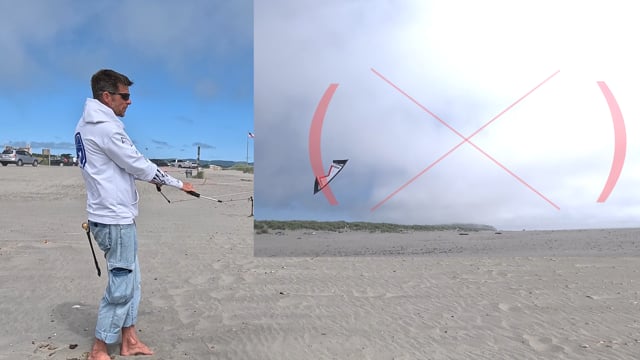
The one skill every Rev pilot must know: stopping your Rev (Club 38 skill #5)
The stop, Club 38 skill no. 5: replacing the urge to pull with a forward push of both thumbs, practised on the simulator.
Basic flight and control, all together
Section titled "Basic flight and control, all together"John Barresi’s tutorial puts the basic inputs together in one flight: launching with a double tap, walking the kite down, open turns, spins, dive stops, short-range jabs and a first flight vocabulary around the wind window.
Flight and control
First steps that matter: launch, steer, keep tension, “throttle” the sail, and stop on command — learn how simple hand moves translate into what the kite does.

The basics of flying
The first flight in light wind: checking the lines, lifting the kite, finding the stable position, then upside down and sideways. You see how to step forward or back to keep your place.

Get Your Rev in the Air: The Basics
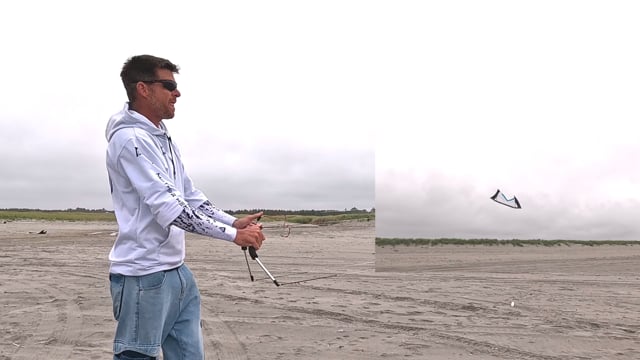
The basics for getting a Rev in the air: setting up the lines, checking before launching, then launching, stopping and backing down, up to turns and side hovers.
4. Reverse, land and relaunch
Section titled "4. Reverse, land and relaunch"Goal: extend your control near the ground and recover after an imperfect landing.
Try this: practise a short reverse movement near the ground, followed by a deliberate landing and a calm relaunch.
Continue when: you can slow down, land the kite and start again without rushing your inputs.
Reversing your kite
Section titled "Reversing your kite"
Reverse flight
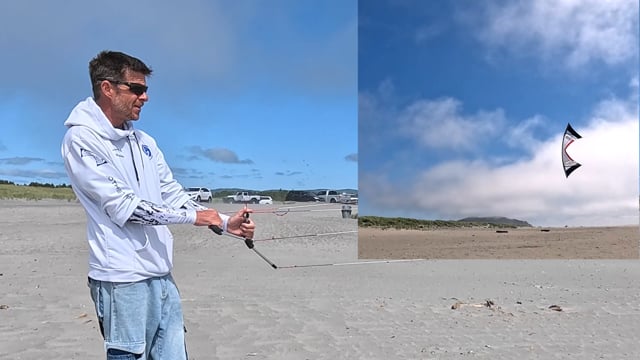
Backward flight, from backing down to flying level in reverse, then reverse take-offs and turns. You see why you pull the brakes just enough, neither too much nor unevenly.
Reverse flight
Flying backward by starting gently, then building pressure on the edge of the hand. The video shows a square flown in reverse and how curves come by themselves.
Launching and landing
Section titled "Launching and landing"Tutorial 1

Launch and landing
Taking off and landing as a team: the classic take-off to start a follow-the-leader, then more elegant variations with a loop. The on-screen text describes each move.

Rollover landing
The rollover landing: flying over kites already landed, turning and landing next to them in line. You see the altitude to hold and the rotation, the same input as a 180.

Launch and land
The first inputs needed to put the kite in the air and bring it down under control.
Tutorial 2
Relaunching a kite lying on the ground
Section titled "Relaunching a kite lying on the ground"
Flat relaunch
Relaunching a kite lying flat, on its belly or face down. You see why a slight movement beats a shake, and on which ground each method works.
Flat relaunches
Relaunching a kite that has fallen flat: on its back, on its face, or inverted and lying backwards. You also see how much the result depends on the ground, sand, grass or hard surface.

How to dead launch your quad kite
Recover a kite lying flat with its leading edge pointing downwind.

Basic reverse launch
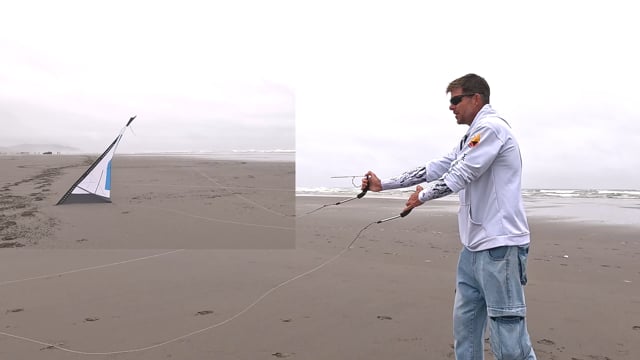
From the inverted position, move one handle thumb forward, and the kite rolls over, leading edge up, ready to take off. In light wind, step back slightly.
Complete tutorial: setup and first flights
Section titled "Complete tutorial: setup and first flights"
Rev Basics: Set-Up, Basic Flying and Pack-Up
The whole cycle of a Rev session, step by step: unrolling the lines, assembling the kite, the first launch and first controls, then packing everything away without tangles.

First Rev Lesson: Level 1 in 20 Minutes
A first-time pilot tries to pass Club 38 level 1 in twenty minutes, then tries a Condor.

Common Rev Problems for Beginners, with Solutions
The most frequent beginner problems with the Rev, seen over thirty years of lessons, and their fix: lopsided launch, a Rev that will not climb, a constant turn, needless backing up and dual-line reflexes.
Djuice quick start
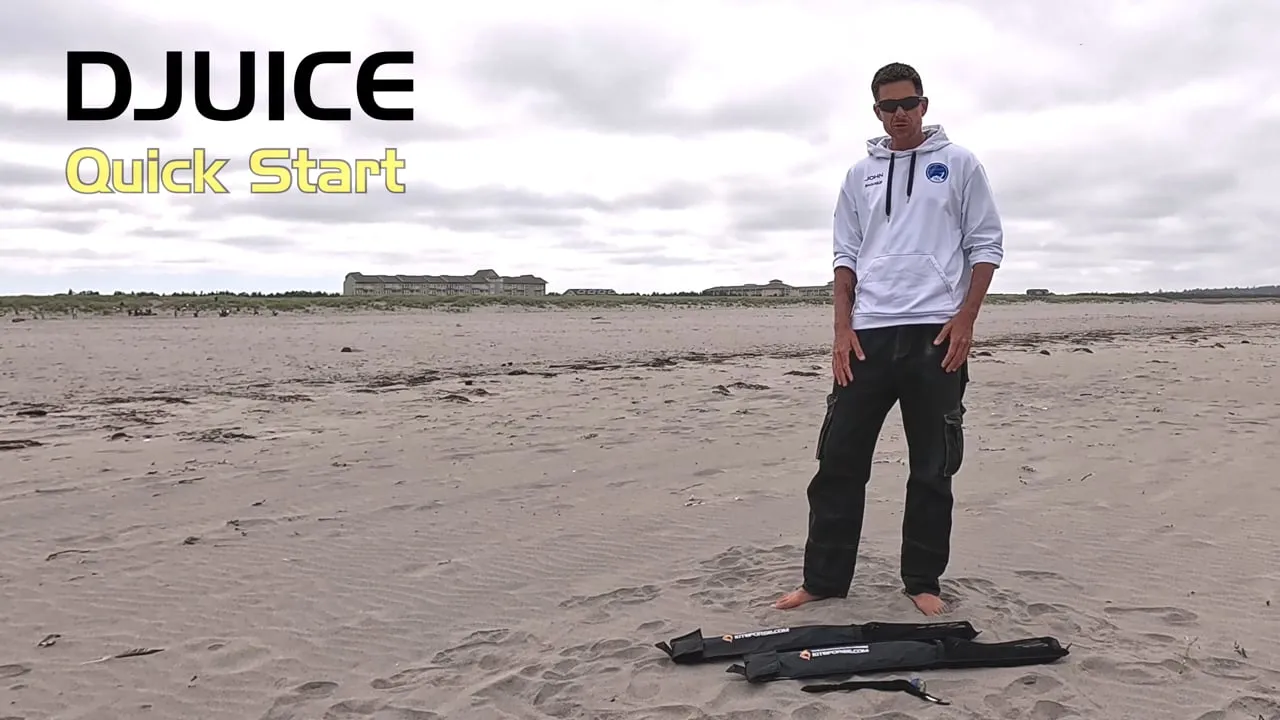
KiteForge's video “manual” for a first quad-line kite, in more than 25 chaptered minutes: assembly, lines, connecting, first flights, leader tuning, wind window and packing up. In English, on the KiteForge website.
Choose your next focus
Section titled "Choose your next focus"If these basics are already comfortable, continue with:
You can also choose a learning method to follow one author’s progression or simply find a useful exercise.
Joe Hadzicki’s Revolution Kites videos cover these basics too: first flights, launching and wind and places to fly.
These external resources offer more exercises and points of view:
- Kite Service tutorials:
- Competing - KiteJust4Fun blog
- Four ways to progress - SportKite.org
- American podcasts - SportKite.org
- Kite anatomy - WindR
- Two-line progression course - WindR
- Quick guide and kite notions - AKA
- Kite basics - AKA
- How to fly a kite - AKA
- Kite flying on the road - lenkdrachen-24.de
What we still want to develop
Section titled "What we still want to develop"- Discover the different types of flying (long lines, short lines, …)
- Indoor flying
Last updated: — more videos at each step, including safety, the flying site and the wind
Did this page help you?
Saving…
We couldn’t save this feedback.
Thanks, your feedback helps us improve this page.
Thanks, your feedback helps us improve this page.