Quad-line tricks and freestyle
Freestyle is often associated with dual-line kites, but quad-line kites also have their own tricks: axels, flic flacs, catches, throws, pancakes and more. This page is a QuadKites.org selection organized by trick, not a learning path ranked from easiest to hardest.
The resources do not all serve the same purpose: some explain the input, while others show a practice session, a demonstration or a slow-motion view. The vocabulary itself is less standardized than in dual-line flying.
Videos are in English or French. You can activate subtitles in the YouTube player if you need to: how to activate subtitles.
Thanks to all the authors of these tutorial and illustrative videos.
How to use this selection
Choose a trick, start with the tutorials when available, then compare the other videos to observe the movement from several perspectives. If you are looking for a more complete method, explore the resources presented by author instead.
If you are still working on launches, stops or landings, start with the basics of flying. For written explanations and animations, see Jordi Morella’s advanced freestyle tricks.
A flat rotation of the kite around its center, triggered by pulling one hand back while the other goes forward. The lines are slack during the turn; once it is complete, you take up the slack to put pressure back into the sail.
Axel
Three axel entries, each followed by a slow-motion replay: lean and pop, static axel from an inverted hover, and diving axel. You also see how the kite and its tuning help the flat spin.

Axel
The axel broken down into setup, rotation and recovery, with the role of footwork and slack. Worth watching to understand why overthinking blocks the trick.

Axel
Trigger a flat rotation and understand the conditions needed for recovery.
Axel
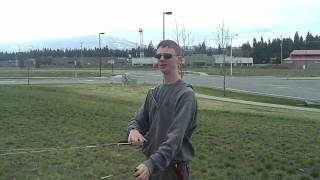
The axel outdoors, from an inverted slide. You see how to judge the slack: too little and the kite does not spin flat, too much and the leading edge hits the ground.

Slow-motion axel

Outward axel
Fly the kite down to the right edge of the wind window and brake it while taking a few steps forward. When the kite is almost flat, give a snap tug on the right brake while pushing the left arm. This is the most difficult axel, because the kite spins outward, which increases the risk of failure from lost lift. Done perfectly and almost flat, the outward axel is the most spectacular axel.

Inward axel
Fly the kite inverted to the right edge of the wind window. When it's stopped and flat enough, give a tug on the left brake while releasing the right arm and taking a few steps forward, letting the lines go slack so the Revolution performs an axel. A well-done axel is as flat as possible.
Indoor axel
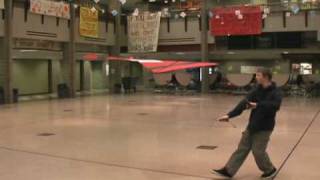
The axel indoors: a small tug on one side, a big one on the other, and a step forward to empty the sail. You also see how to refill the sail after the spin to catch the kite before it hits the ground.
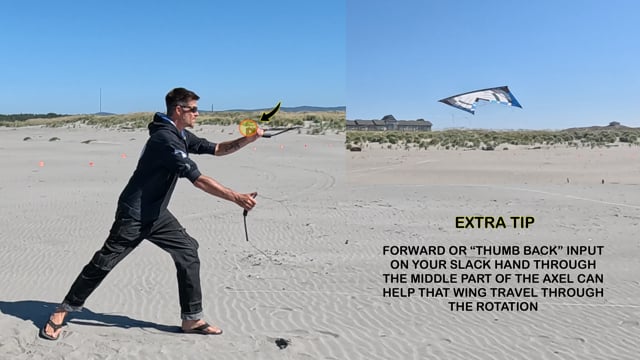
Carl Robertshaw. In the Flying Techniques video, the axel on a Revolution: lots of reverse, then a sharp tug on the same handle while giving lots of slack on the other. Starting a rotation in the direction of the axel first gives momentum, and heavy spars help with practice. See the chapter Axels on a Revolution.
Flic flac
Section titled "Flic flac"From a hover, the kite is made to tip over backward, like a back flip, so that you see the back of the sail. A quick pull on the top lines then flips it straight back to its normal position. Repeated rhythmically, it makes a series of flips. Kitelife also offers a complete tutorial.

Flic flac preview
A minute of flic flac on a Revolution, to see the technique; the full step-by-step tutorial is for KiteLife subscribers.

Flic flac
The flic flac from a hover: tipping the kite backwards, then bringing it back with a quick pull on the top lines. You also see how to chain it into a clockwork.

Flic flac
With the kite stalled, give a brake tug while taking half a step forward, then a second brake tug. The flic flac must be done without losing height.

Inverted flic flac
With the kite stalled in the inverted position, give a brake tug while taking half a step forward, then a second brake tug. The inverted flic flac should be done without losing height.

Vertical flic flac
With the Revolution stopped vertically, do a flic flac with more sensitive wrists. The two brake tugs must be precisely synchronized, and the flic flac must be done without losing height.
Carl Robertshaw. In the Flying Techniques video, a flic flac on a Revolution, made possible by moving the bridle point towards the tips, at the cost of a leading edge that bends more; the flier explains the return to the standard setup. See the chapters A flic flac on a Revolution and Moving the bridle point.
Catch and throw
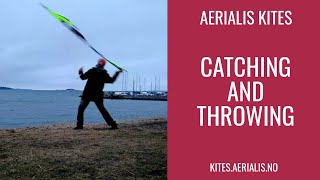
Section titled "Catch and throw"Also called catch and throw, it is a move from 3D flying, on short lines: a sharp pull on the top two lines brings the kite down into your hand (the catch), then you throw it back into the air like a javelin (the toss) and fly away. Spence Watson’s tutorial breaks the catch and the toss down; the other videos mainly show drills and practice sessions.

Toss and catch
The toss and catch outdoors: bringing the kite down into your hand with a sharp pull on the top lines, then throwing it back like a javelin.

Catch and throw drills

Axel and catch practice

Short freestyle sequence
Catch and throw
Bring the kite back to your hand and throw it into flight in light wind on short lines.

Revolution Reflex 3-D Catch and Throw
The short-line catch and throw, the old way, with the Rev stalling and falling, or with the Reflex, gliding to the pilot: both methods compared, in four steps for the second.

Indoor Rev: basic catch and throw
Catching and throwing an indoor Revolution. You see how to work the lines so it comes to your hand, then the check to make before each throw.

Pull & catch and trow-out launch
Pull, catch, throw: dropping the kite from the top of the window, catching it by the leading edge, then throwing it like a javelin and taking control again.

Indoor toss and catch
Catching and throwing indoors: two catches and five or six throws, from the javelin to throws held by the V. You see how to keep air in the sail before a throw.
Carl Robertshaw. In the Flying Techniques video, catching the kite from the top of the window, both handles in one hand, then two ways to throw it out again: a finger behind the bridle knot, or around the end cap. See the chapter Catching the kite.
Falling leaf
Section titled "Falling leaf"A flic flac that waits: the kite is flipped onto its back by a pop on the bottom lines, then left to fall on slack lines like a leaf, and flipped back by a hard pull on the bottom lines just before it reaches the ground.

Falling leaf
The falling leaf, a flic flac that waits: the kite falls on its back and flips just above the ground. You see why to start at the top of the window and how to give slack by running forward.

Falling leaf
Pop the kite out of flight, let it fall like a leaf, then recover it.
Clam roll
Section titled "Clam roll"A more advanced cousin of the flic flac: the kite makes the first flip and sticks to the ground in its landed position. You can leave it there as long as you like, then a similar input snaps it back onto its feet. Jordi Morella also describes it in writing.
Clam roll
The clam roll, a flic flac that stays down on the ground before snapping back up. The video details the wrist pop, the slack to give and the two most common mistakes.
Clam roll
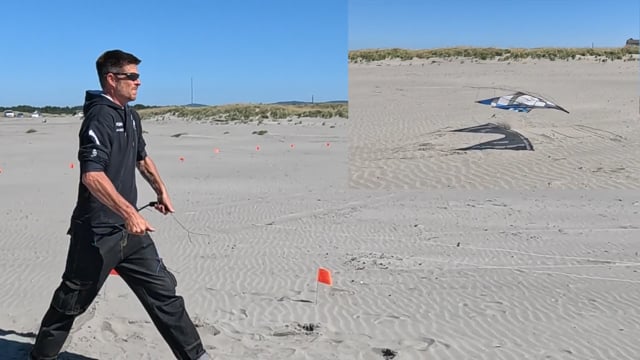
Geoff Hutton’s video follows his 78 attempts at learning it. What made the difference, he explains, was to start with the hands lower and strike with the wrists rather than the elbows: too much elbow adds brake input and sends the kite on a reverse “U” toward you instead of pivoting in place. The trick itself appears at 2:32.
Pancake
Section titled "Pancake"The kite is brought down belly-down onto the ground by snapping both brakes hard when it is a few dozen centimeters from the ground, with a step forward; to take off, step back and let the wind refill the sail. The Fly 4 Fun learning path, made by Stack Italia with Guido Maiocchi and several European champions, includes a tutorial dedicated to it.

Pancake
This trick works best in light wind with an ultralight Revolution. Do a power dive with both handles near your hips. When the kite is about one meter from the ground, push both arms out while taking a few steps forward. To recover, pull your arms and take one step backward.

Indoor pancake
The pancake indoors, then its catch and the axel catch. You see how to bring the kite to you and grab it by the V.
Two videos temporarily unavailable
Thierry Bressure’s “Pancake training” and “Ventouse ou pancake au ralenti” videos are awaiting republication. They will return here as soon as their new addresses are available.
The kite flies a full circle around the pilot, who turns on the spot while walking backwards to make the wind. It is the basic indoor move: with no wind, the pilot walks backwards in a circle. Outdoors, it remains possible in light, steady wind by compensating for the wind: the pilot’s path then stretches out into an oval rather than a circle. With the Reflex, the Rev can also glide around the pilot, even in gusty wind.

360 lesson
The basic figure of the indoor school: flying in circles while walking back, the kite upright. The video shows how to use walking speed, compensation and tilt to manage altitude.

Indoor Rev: launch and 360
The first indoor take-off, against a wall or without one, then the 360. You see why flying indoors means saving movement and keeping pressure in the sail.

New Revolution Fly and Glide Skill: The Revolution Reflex 360
The Reflex 360, a fly-and-glide trick: where the classic 360 requires running backward in very steady wind, the Reflex glides the Rev around the pilot, even in gusty wind.
More tricks to explore
Section titled "More tricks to explore"Jordi Morella’s path also explains the fade and a catch from the ground. Spencer Watson’s Windy With Watty series gathers outdoor tricks (bicycle spin, clockwork, toss and catch, axel, flic flac and falling leaf), and Windless With Watty covers the indoor fade, pancake, sweep, whiplash and guillotine. The Fly 4 Fun catalogue brings together many individual tricks and combinations.
Explore other approaches
Section titled "Explore other approaches"Explore resources by author: each retains its own vocabulary, exercises, and, when it has one, order of progression.
The Revolution Kites videos on spins, hover and reverse also cover the 3D toss and the catch and throw with the Reflex.
Last updated: — videos grouped by trick, new videos on the axel, flic flac, catch and throw, falling leaf and pancake, and a section on the 360
Did this page help you?
Saving…
We couldn’t save this feedback.
Thanks, your feedback helps us improve this page.
Thanks, your feedback helps us improve this page.